
Search
Remove Ads
Advertisement
Search Results
Image
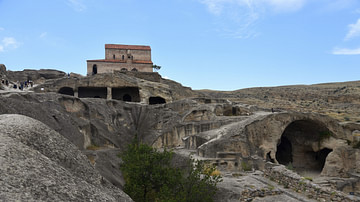
Uplistsikhe Cave Town, Georgia
Uplistsikhe is an ancient rock-hewn town in Georgia, featuring a complex of caves and tunnels carved into the rock. Dating back to the early Iron Age (c. 1000 BCE), it served as a significant political, religious...
Image
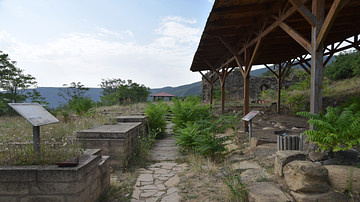
Armaziskhevi Archaeological Site, Georgia
1st-century CE six-apse pagan temple on the left and 3rd-century CE wine cellar on the right, complete with qvevris (large earthenware jars buried under the ground for fermentation and storage). Armaziskhevi...

Article
Queen Hatshepsut: Daughter of Amun, Pharaoh of Egypt
Hatshepsut, whose name means "Foremost of Noble Women" or "First Among Noble Women" (royal name, Ma'at-ka-re, translated as "spirit of harmony and truth") was the fifth ruler of the 18th Dynasty (r...
Article
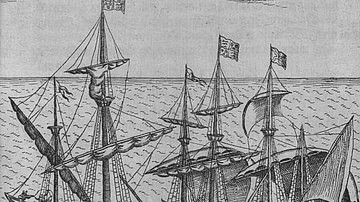
The Sea Dogs - Queen Elizabeth's Privateers
The sea dogs, as they were disparagingly called by the Spanish authorities, were privateers who, with the consent and sometimes financial support of Elizabeth I of England (r. 1558-1603 CE), attacked and...

Definition
Anne Boleyn
Anne Boleyn (c. 1501-1536) was the second wife of Henry VIII of England (r. 1509-1547). Anne, sometimes known as 'Anne of a Thousand Days' in reference to her short reign as queen, was accused of adultery and executed in the Tower...
Image
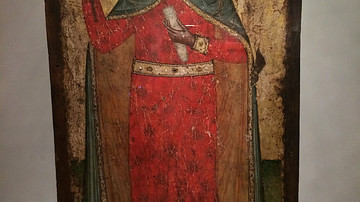
Painted Icon of St. Nino of Georgia
This painted icon from the Church of the Dormition of the Virgin (or Davit Aghmashenebeli Church) at Shiomghvime Monastery is dated to the Middle Ages or as late as the 17th century CE. The icon rendered in Byzantine...
Image
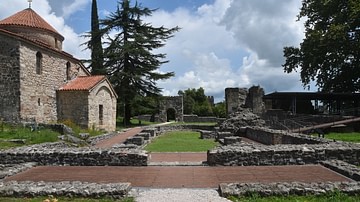
Ruins inside Archaeopolis (Nokalakevi), Georgia
Ruins inside the Byzantine Fortress of Archaeopolis (Nokalakevi) and the 6th-century CE Forty Martyrs’ Church, originally built as an aisled basilica and later reconstructed several times and turned into...
Image
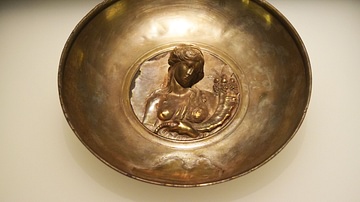
Goddess Phiale from Ancient Georgia
This phiale comes from the Armaziskhevi archaeological site in Georgia and dates from the 2nd century CE. The medallion of the phiale features a goddess — Fortuna or Amalthea — with cornucopia. Separate parts of...
Image
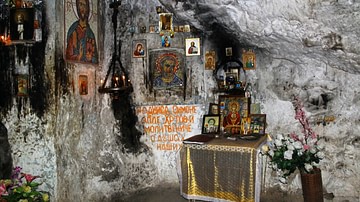
St. Simon the Zealot's cave in Abkhazia, Georgia
A photo showing St. Simon the Zealot's cave in Abkhazia, Georgia.
Image
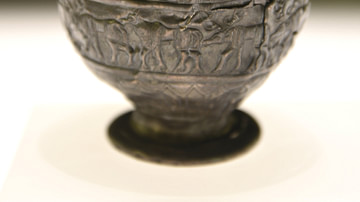
Trialeti Chalice from Georgia
The Trialeti Chalice, a silver cup from Trialeti, made by people who belonged to the ancient Trialeti-Vanadzor culture, 18th or 17th centuries BCE. The cup is decorated with two processional friezes. The upper frieze...
