
Search
Remove Ads
Advertisement
Search Results

Definition
Perdiccas
Perdiccas (d. 321 BCE) was one of Alexander the Great's commanders, and after his death, custodian of the treasury, regent over Philip III and Alexander IV, and commander of the royal army. When Alexander the Great crossed the Hellespont...
Definition
Paestum
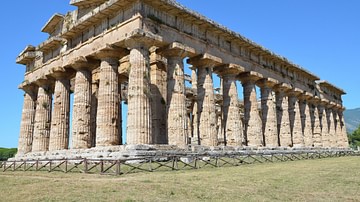
Paestum, also known by its original Greek name as Poseidonia, was a Greek colony founded on the west coast of Italy, some 80 km south of modern-day Naples. Prospering as a trade centre it was conquered first by the Lucanians and then...
Definition
Metapontum
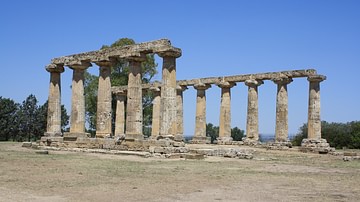
Metapontum, located on the southern coast of Basilicata, Italy, was an Achaean colony founded in the late 8th century BCE. Thriving on agriculture and trade, the city became one of the most prosperous colonies in Magna Graecia. Today...
Definition
Titus Quinctius Flamininus
Titus Quinctius Flamininus (229-174 BCE) was a consul and military commander of the Roman Republic during the Second Macedonian War, who decisively defeated Philip V of Macedon (r. 221-179 BCE) at the Battle of Cynoscephalae...
Image
Andronikos III Palaiologos
Andronikos III Palaiologos, Byzantine Emperor (r. 1328-1341 CE). 14th-century CE miniature. Stuttgart, Württembergische Landesbibliothek.

Image
Coronation of Manfred
Manfred is crowned King of Sicily (1258 CE).
Miniature from the Chronicle of Giovanni Villani.
Second half of the 13th century CE.
Vatican City, Biblioteca Apostolica Vaticana, Cod. Chigi L VIII 296, fol. 85r.

Image
Map of the Successor Kingdoms, c. 303 BCE
Map of the Diadochi successor kingdoms to Alexander the Great's empire, before the Battle of Ipsus (301 BCE).

Image
Theatre of Dodona
The theatre of Dodona, 3rd century BCE.

Article
Winged Victory: the Nike of Samothrace
One of the most celebrated works of Hellenistic art is without doubt the Nike of Samothrace, on display at the Louvre since 1884 CE. The white Parian marble statue represents the personification of winged victory...

Article
Dogs & Their Collars in Ancient Greece
Dogs in ancient Greece are regularly depicted in art, on ceramics, in literature, and other written works as loyal companions, guardians, hunters, and even as great intuitive thinkers; all of these expressing...
