
Search
Remove Ads
Advertisement
Search Results

Image
Pyrrhic War
A map showing the movements of Pyrrhus, King of Epirus in his campaigns in Italy against Rome. Pyrrhus was victorious in the battles of Heraclea in 280 BCE and Ausculum in 279 BCE but lost at Maleventum in 275 BCE.

Definition
Roman Republic
In the late 6th century BCE, the small city-state of Rome overthrew the shackles of monarchy and created a republican government that, in theory if not always in practice, represented the wishes of its citizens. From this basis...

Definition
Thessalonica
Thessalonica (also Thessalonike) was an ancient city of Macedon in northern Greece which today is the city of Thessaloniki. Made capital of the Roman province of Macedon, the city flourished due to its location on the major trade...

Definition
Stilicho
Flavius Stilicho (365-408 CE) was a Roman army commander, who rose in the ranks under the reign of Roman emperor Theodosius I (r. 378-395 CE) and eventually became the regent to his son Honorius (r. 395-423 CE). Stilicho fought with...
Definition
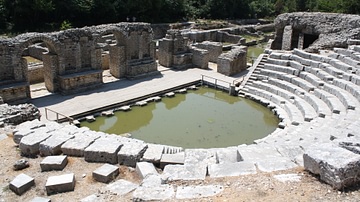
Butrint
Butrint (ancient name Buthrotum) is located on the fertile coast of Epirus in present-day Albania and was an important settlement in Hellenistic and Roman times due to its position on the route from Italy to mainland Greece down the...

Article
Pausanius' Guide To Ancient Athens
Pausanius (l. 110-180 CE) was a geographer and historian who traveled extensively, taking notes on points of interest, then wrote on them in guide books which could be used by tourists visiting the sites described...

Definition
Byzantine Empire
The Byzantine Empire existed from 330 to 1453. It is often called the Eastern Roman Empire or simply Byzantium. The Byzantine capital was founded at Constantinople by Constantine I (r. 306-337). The Byzantine Empire varied in...

Definition
Fourth Crusade
The Fourth Crusade (1202-1204 CE) was called by Pope Innocent III (r. 1198-1216 CE) to retake Jerusalem from its current Muslim overlords. However, in a bizarre combination of cock-ups, financial constraints, and Venetian trading...

Definition
Empire of Nicaea
The Empire of Nicaea was a successor state to the Byzantine Empire, or rather a Byzantine Empire in exile lasting from 1204 to 1261 CE. The Empire of Nicaea was founded in the aftermath of the sacking of Constantinople during...

Article
The Extent of the Roman Empire
Time has seen the rise and fall of a number of great empires - the Babylonian, the Assyrian, the Egyptian, and lastly, the Persian. Regardless of the size or skill of their army or the capabilities of their leaders...
