
Search
Remove Ads
Advertisement
Search Results

Article
The Celtic Invasion of Greece
Between the 5th and 4th centuries BCE, Celtic tribes moved en masse into southern Europe, intent on seizing land and wealth to feed their swelling numbers. As these tribes began crossing the Alps, they came into conflict...

Definition
Roman Warfare
Roman warfare was remarkably successful over many centuries and across many territories. This was due to several important factors. Italy was a peninsula not easily attacked, there was a huge pool of fighting men to draw upon, a...

Definition
Hellenistic Period
The Hellenistic Period is a part of the Ancient Period for the European and Near Asian space. The use of this period is justified by the extent of the Hellenic culture in most of these areas, due to the Greek political presence...

Definition
Seleucus I Nicator
Seleucus I Nicator (l. c. 358-281 BCE, r. 305-281 BCE) was one of the generals of Alexander the Great (l. 356-323 BCE) who made up the group of Diadochi ("successors") who divided the vast Macedonian Empire between them after...

Definition
Antigonus I
Antigonus I Monophthalmus ("the One-Eyed") (382 -301 BCE) was one of the successor kings to Alexander the Great, controlling Macedonia and Greece. When Alexander the Great died in 323 BCE, a conflict known as the Wars of the Diadochi...

Definition
Hellenistic Warfare
When Alexander the Great died in 323 BCE, he left behind an empire devoid of leadership. Without a named successor or heir, the old commanders simply divided the kingdom among themselves. For the next three decades, they fought...

Article
Alexander the Great as a God
The age-old concept of the “divine right of kings” allowed that a country's ruler received his or her power or authority from God. However, few, if any, were delusional enough to actually believe themselves to be a god...
Article
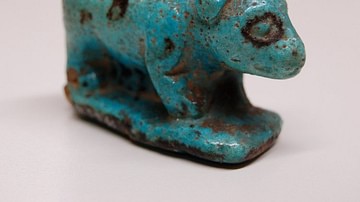
Dogs in Ancient Egypt
The dog as "man's best friend" has a long history going back to the ages long before the civilization of ancient Egypt was established but the Egyptians were among the earliest people to recognize the value of the dog and...

Article
The Hellenistic World: The World of Alexander the Great
The Hellenistic World (from the Greek word Hellas for Greece) is the known world after the conquests of Alexander the Great and corresponds roughly with the Hellenistic Period of ancient Greece...
Image
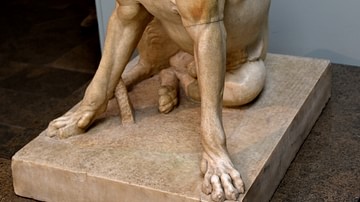
Molossian Hound
The Molossi inhabited ancient Epirus (modern northern Greece and Albania). This dog once wore a collar. Its gaping jaws show powerful teeth, but the relaxed pose and upward gaze give it an obedient air. Five other versions of...
