
Search
Did you mean: Pompey?
Remove Ads
Advertisement
Search Results

Definition
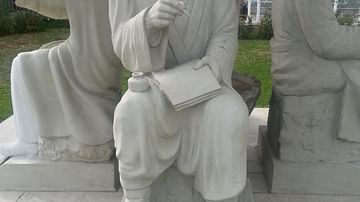
Critias
Critias (l. c. 460-403 BCE) was an Athenian politician, poet, and playwright, one of Socrates' followers, Plato's second cousin, a leading member of the Thirty Tyrants of Athens, and leader of the oligarchy they established. He is referenced...
Definition
Omar Khayyam
Omar Khayyam (also given as Umar Khayyam, l. 1048-1131 CE) was a Persian polymath, astronomer, mathematician, and philosopher but is best known in the West as a poet, the author of The Rubaiyat of Omar Khayyam. His famous work has...

Definition
Herman Melville
Herman Melville (1819-1891) was a 19th-century American author of novels, short stories and poetry. He is best known for his novel Moby Dick, published in 1851, and his short stories Bartleby the Scrivner and Billy Budd, Sailor...

Definition
Ihara Saikaku
Ihara Saikaku (1642-1693) was a Japanese poet and novelist who played a leading role in creating the so-called ‘floating world’ (ukiyo-zoshi) genre of popular literature in the 17th century. His work was significant because, in...

Definition
Marcus Annaeus Lucanus
Marcus Annaeus Lucanus (39-65 CE), grandson of Seneca the Elder and nephew of Seneca the Younger, was a Roman statesman and Latin poet. Born in Corduba, he came to Rome as an infant and later held the positions of quaestor...
Definition
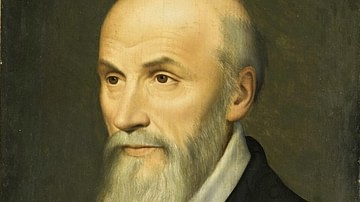
Michel de L'Hospital
Michel de L'Hospital (also known as L'Hôpital, c. 1505-1573) was a French statesman who served during the reigns of four kings – Francis I, Henry II, Francis II, and Charles IX – as Councillor of Parlement (1537), Chancellor...

Book Review
Humsafar: The World of Urdu Poetry
“Humsafar” is an Urdu word which means "companion." True to its name, this book acts as a friend to guide the audience through the complex world of Urdu poetry. Hitesh Gupta Aadil is an Urdu language and literature...
Collection
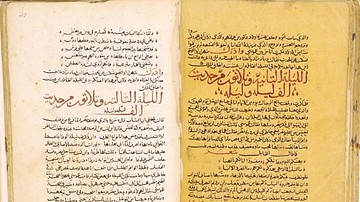
Persian Poets and Literature
Persian literature is usually dated to the Behistun Inscription of Darius I (the Great, r. 522-486 BCE) at c. 522 BCE. It is generally understood that a significant body of work was created by Persian writers between...

Article
Nine Realms of Norse Cosmology
Norse cosmology divided the universe into nine realms. The center of the universe was the great world-tree Yggdrasil and the nine realms either spread out from the tree or existed in levels stretching from the roots...

Article
Religion in the Middle Ages
Religion in the Middle Ages, though dominated by the Catholic Church, was far more varied than only orthodox Christianity. In the Early Middle Ages (c. 476-1000), long-established pagan beliefs and practices entwined...
