
Search
Search Results

Article
LGBTQ+ in the Ancient World
In the cultures of the ancient world, there was no need for designations such as LGBTQ+ because there was no difference noted between what is now defined as "homosexual" and "heterosexual" relationships. There was no "us" and "them" dichotomy...

Article
The Army of Alexander the Great
No military commander in history has ever won a battle by himself. To be successful he needs the support of a well-trained army who will follow him regardless of the cost whether it be a stunning victory or hopeless defeat. One need only...

Article
Mythological Re-Enactments in Ancient Roman Spectacle
To this day the ancient Romans remain infamous for their dramatic use of spectacle and other forms of entertainment. A lesser known variation of Roman spectacle is the mythological re-enactments that took place during the ludi meridiani (midday...

Article
The Arch of Constantine, Rome
The Arch of Constantine I, erected in c. 315 CE, stands in Rome and commemorates Roman Emperor Constantine's victory over the Roman tyrant Maxentius on 28th October 312 CE at the battle of Milvian Bridge in Rome. It is the largest surviving...

Article
Five Key Historical Sites of the Hittites
Although mentioned several times in the Biblical texts, the actual existence of the Hittites was largely forgotten until the late 19th century CE. With the discovery of Hattusa in 1834 CE, the city that was for many years the capital of the...

Article
Ai Khanum, the Capital of Eucratides
Ai Khanum (also spelled Ai-Khanoum or Ay-Khanum, lit. “Lady Moon” in Uzbek), was founded in the 4th century BC, following the conquests of Alexander the Great and was one of the primary cities of the Greco-Bactrian kingdom. The site is located...
Article
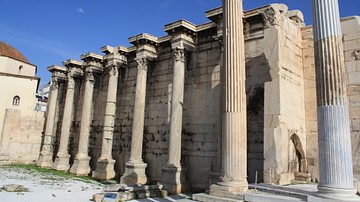
The Library of Hadrian, Athens
The Library of Hadrian (aka Hadrian's Library) in Athens was constructed circa 132-134 CE as part of Roman Emperor Hadrian's grand re-building plan for the city. The library was the largest in Athens and with its columned façade and high...
Article
The Life of Aristippus in Diogenes Laertius
Aristippus of Cyrene (l. c. 435-356 BCE) was a hedonistic Greek philosopher who taught that the meaning of life was pleasure and that the pursuit of pleasure, therefore, was the most noble path one could pursue. Along with Plato, Xenophon...

Article
Museums in the Ancient Mediterranean
Museums have been around much longer than one might think, but in the ancient world, they were principally institutions of research and learning rather than places to display artworks and artefacts, even if they were often located in grand...

Article
10 Virtual Tours of Archaeological Sites & Museums in Turkey
Thanks to the new Sanal Muze digital portal released by the Ministry of Culture and Tourism of Turkey in 2020 CE, history lovers and art enthusiasts can now take virtual tours of Turkey's best archaeological sites and museums. There are currently...
