
Search
Search Results

Definition
Hypaspist
The hypaspists or hypaspistai were a distinct type of infantry soldier who served as a vital part of the Macedonian armies of both Phillip II of Macedon (r. 359 BCE - 336 BCE) and his son and heir Alexander the Great (r. 336-323 BCE). The...

Definition
Gordium
Gordium was the capital of ancient Phrygia, modern Yassihüyük. It is situated on the place where the ancient Royal road between Lydia and Assyria/Babylonia crosses the river Sangarius, which flows from central Anatolia to the Black Sea. Remains...

Definition
Antisthenes of Athens
Antisthenes of Athens (l. c. 445-365 BCE) was a Greek philosopher who founded the Cynic School. He was a follower of Socrates and appears in Plato's Phaedo as one of those present at Socrates' death. He is also one of the primary interlocutors...

Image
Mosaic of Amazon Warrior Fighting Greek Rider
An ancient Roman mosaic from the 4th century CE depicting an Amazon warrior in mounted combat against a Greek rider. The Greek is seizing the Phrygian cap of the Amazon. Cropped detail of a mosaic from Daphne, a suburb of Antioch on the Orontes...
Image
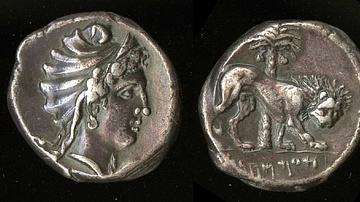
Dido, Carthaginian Tetradrachm
A silver tetradrachm from Carthage. The female head has been identified by some historians as Dido (Elissa), the legendary founder of the city. Other historians identify the figure as the goddess Tanit (aka Tinnit). She wears a Phrygian cap...
Image
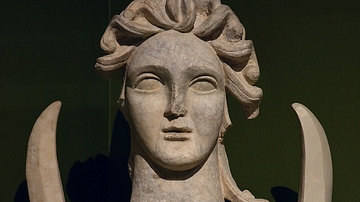
Bust of Mên, the Moon God of Anatolia
Bust of Mên, the Moon God worshipped in the western interior parts of Anatolia. He wears the Phrygian cap and the crescent moon seem to emerge from his shoulders. Roman period (Museum of Anatolian Civilizations, Ankara).
Image
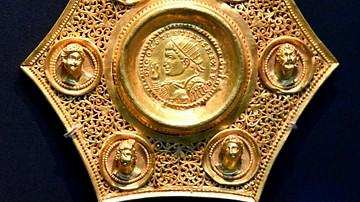
Gold Coin Pendant of Constantine
Gold pendant set with a coin of Constantine the Great, c 320s CE. The British Museum, London. The pendant is made in a pierced metalwork technique popular in fine jewellery of the time. The obverse of the coin depicts a bust of Constantine...
Image
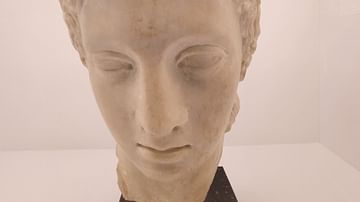
Head of a Statue of Paris
Paris, son of Troy's King Priam and Hecuba, is wearing a Phrygian cap, the characteristic headgear of shepherds. According to the myth, an interpreter of dreams foretold that the child of Hecuba would bring the destruction of Troy and must...
Image
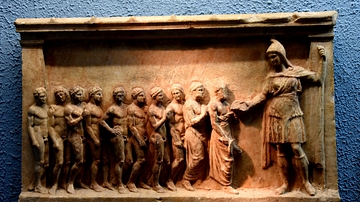
Votive Relief Dedicated to Artemis Bendis
This is a marble votive relief dedicated to the goddess Artemis Bendis. The cult of the Thracian goddess Bendis (similar to the Greek Artemis) was introduced to Athens around 430 BCE along with other foreign cults. Here, the goddess is shown...
Image
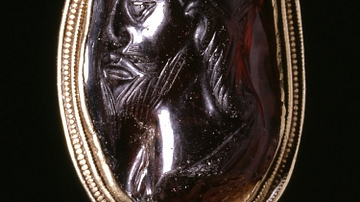
Byzantine Pendant from Ewell, England
Known as the Ewell Pendant, this piece was made in the late 7th century CE in the Mediterranean. It features a bearded man wearing a phrygian cap. Made of gold and garnet. Measures 32 x 21.5 x 9 mm. Found in Ewell, England (British Museum...
