
Search
Did you mean: Pharaoh?
Remove Ads
Advertisement
Search Results

Definition
Constans II
Constans II (aka Konstans II) was emperor of the Byzantine Empire from 641 to 668 CE. Sometimes known as Constans Pogonatos (“the Bearded”), he came to the throne by a series of unlikely events and his empire was immediately challenged...

Definition
Byzantine Architecture
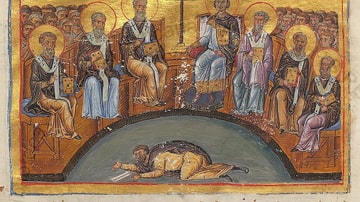
The architecture of the Byzantine Empire (4th - 15th century CE) continued its early Roman traditions but architects also added new structures to their already formidable repertoire, notably improved fortification walls and...
Definition
Constantine VI
Constantine VI, also known as Constantine "the Blinded”, was emperor of the Byzantine Empire from 780 to 797 CE, although for most of his reign his mother, Irene the Athenian, ruled as regent. When Constantine did finally get a...

Definition
Prometheus Bound
The Greek dramatist Aeschylus (c. 525 - c. 456 BCE) is considered one of the greatest tragic playwrights of his generation. He is often referred to as the “Father of Greek Tragedy.” Older than both Sophocles and Euripides, he...

Definition
Urartu Religion
The religion of the Urartu civilization, which flourished principally in ancient Armenia from the 9th to 6th century BCE, was a unique mix of indigenous, Hurrian and Mesopotamian gods and symbolism. The pantheon was headed by...

Definition
Battle of the Metaurus
The Battle of the Metaurus (207 BCE) was a military engagement fought between the forces of Rome under Gaius Claudius Nero (c. 237 - c. 199 BCE), Marcus Livius Salinator (254-204 BCE), and L. Porcius Licinius and the Carthaginians...

Definition
The Frogs
The Frogs is a comedy play by Aristophanes (c. 445 - c. 385 BCE), the most famous of the comic playwrights of ancient Greece. Named after the creatures who composed the play's chorus, it won first prize at the dramatic festival at...

Definition
Armenian Mythology
The mythology of ancient Armenia is a rich blend of indigenous traditions with imported ideas from neighbouring cultures and migrating peoples added over the centuries. The legends and stories helped to explain natural phenomena...

Definition
Mesrop Mashtots
Mesrop Mashtots (360/370 - c. 440 CE) invented the Armenian alphabet in 405 CE. Besides greatly increasing levels of literacy in the country, the language permitted ordinary people to read the Bible for the first time, thus helping...

Definition
Knights Templar
The Knights Templar were established c. 1119 and given papal recognition in 1129. It was a Catholic medieval military order whose members combined martial prowess with a monastic life to defend Christian holy sites and pilgrims...
