
Search
Remove Ads
Advertisement
Search Results
Image
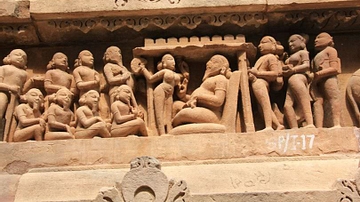
School Scene, Khajuraho
A class in session. The potbellied teacher is being fanned by a servant girl while he gives the lessons. His students surround him; one has a satchel across his back, another has a tablet under his arm. Khajuraho, Madhya...

Definition
Teng Shih
Teng Shih (l. c. 500 BCE) was a Chinese Sophist and lawyer who lived and wrote in the province of Cheng (Pengcheng, modern-day Xuzhou, Jiangsu province) during the era of the Spring and Autumn Period (c. 772-476 BCE) which preceded...

Definition
Cyrenaics
The Cyrenaics were a philosophical school of thought founded c. 4th century BCE by Aristippus of Cyrene (l. c. 435-356 BCE) who taught that sensual pleasure was the highest good and only worthwhile pursuit in life. Known as the first...

Article
Mesopotamian Education - Creating the First Written Works in History
Mesopotamian education was invented by the Sumerians following the creation of writing circa 3600/3500 BCE. The earliest schools were attached to temples, but later schools were established...

Definition
Confucianism
Confucianism is a philosophy developed in 6th-century BCE China, which is considered by some a secular-humanist belief system, by some a religion, and by others a social code. The broad range of subjects touched on by Confucianism...

Definition
Sima Qian
Sima Qian (l. 145/135-86 BCE) was a court scribe, astrologer, and historian of the Han Dynasty (202 BCE - 220 CE) of ancient China, famous for his historical work Records of the Grand Historian for which he is remembered as the Father...

Definition
Xunzi
Xunzi (pronounced shund-zee, l. c. 310-c. 235 BCE) was a Confucian philosopher of the Warring States Period (c. 481-221 BCE) in China. He is also known as Hun Kuang, Hsun Tzu, Xun Tzu, and Xun Kuang. Xunzi translates as Master Xun and...

Definition
The Clouds
The Clouds is a comedy written c. 423 BCE by the Greek playwright Aristophanes (c. 448 BCE – c. 385 BCE). A failure at the Dionysia competition, finishing third out of three, it was revised later in 418 BCE but never produced in the...

Definition
Aristotle
Aristotle of Stagira (l. 384-322 BCE) was a Greek philosopher who pioneered systematic, scientific examination in literally every area of human knowledge and was known, in his time, as "the man who knew everything" and later simply...

Definition
Greek Philosophy
Ancient Greek philosophy is a system of thought, first developed in the 6th century BCE, which was informed by a focus on the First Cause of observable phenomena. Prior to the development of this system by Thales of Miletus (l...
