
Search
Remove Ads
Advertisement
Search Results

Article
Ai Khanum, the Capital of Eucratides
Ai Khanum (also spelled Ai-Khanoum or Ay-Khanum, lit. “Lady Moon” in Uzbek), was founded in the 4th century BC, following the conquests of Alexander the Great and was one of the primary cities of the Greco-Bactrian...

Image
Distribution of Bounty, 1846
A watercolour painting by Joseph Nash (1809-78) of the Riding School Hall at Windsor Castle and showing the distribution of bounty to the poor on 1 January 1846 organised by Queen Victoria (reign 1837-1901). (Royal Collection...

Definition
Philosophy
The word philosophy comes from the Greek philo (love) and sophia (wisdom) and so is literally defined as “the love of wisdom”. More broadly understood, it is the study of the most basic and profound matters of human existence. Philosophical...

Definition
Archelaus (Philosopher)
Archelaus of Athens (l. c. 5th century BCE) was a Pre-Socratic philosopher in ancient Greece who claimed the first cause of existence was the opposition of cold and heat which caused the separation of the universal essence...

Definition
Melissus of Samos
Melissus of Samos (l. c. 5th century BCE) was a Greek philosopher of the Eleatic School, considered the third great proponent of that philosophy's claim that reality is One, after Parmenides (l. c. 485 BCE) and Zeno of Elea (l...

Definition
Romani
Romani is an umbrella term used to describe a diverse ethnolinguistic group of people with a historical presence in Europe and West Asia. The historically common term 'Gypsy' is based on the myth that they came from Egypt. In reality...

Article
The Life of Aristippus in Diogenes Laertius
Aristippus of Cyrene (l. c. 435-356 BCE) was a hedonistic Greek philosopher who taught that the meaning of life was pleasure and that the pursuit of pleasure, therefore, was the most noble path one could...
Article
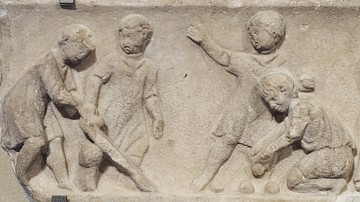
Childhood in Ancient Rome
Freeborn Roman children, ingenuiae, born of Roman citizen parents lived a life that was dictated by the level of society into which they were born; a day in the life of a child from the lower level of society and one from...

Article
Ten Halloween Facts and Traditions You Need to Know - A Celebration of Transformation
Halloween is the most popular holiday in the world, after Christmas (based on level-of-celebration and consumer spending) and, increasingly, the most lucrative. According...

Article
Tibetan Sand Mandalas
Tibetan sand mandalas are works of art created to encourage healing, peace, and purification generally as well as spiritual or psychological focus specifically for those creating and viewing it. A mandala (Sanskrit for "circle"...
