
Search
Remove Ads
Advertisement

 This answer was generated by
 Search Results

Image
Panathenaic Procession
Block XLIV of the South Frieze of the Parthenon Sculptures. Attributed to Pheidias 438BC-432 BCE. Detail of a cow being led to sacrifice by four youths. The cow does not seem to be too happy about this. The two youths at...

Image
Panathenaic Games Prize Amphora
Panathenaic Games prize amphora, terracotta vase decorated by the Euphiletos Painter, c. 530 BCE. The artwork on this vase is attributed to the Athenian artist known today as the Euphiletos Painter (c. 550 to c. 500...

Image
The Panathenaic Way, Athens, Greece
The Panathenaic Way was the road leading from the main gate of Athens up to the Acropolis and built for the purpose of the great Panathenaia religious festival.
Image
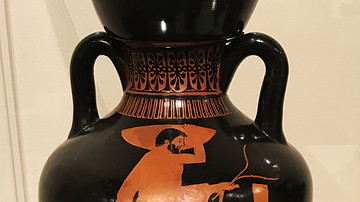
Amphora of a Panathenaic Shape
This red-figure terracotta vase was made by the Eucharides Painter (c. 500-475 BCE) who worked in Athens, Greece during the Archaic Period (1000-480 BCE). This piece dates from 480 BCE. (Iris & B. Gerald Cantor Center...
Image
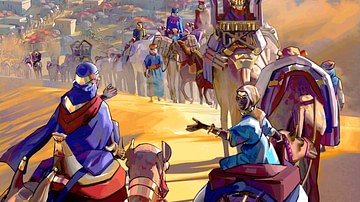
Ghanaian Royal Procession
Artist's impression of a royal procession in the medieval Ghana Empire. Created by Amplitude Studios for the video game Humankind.

Definition
Acropolis
An acropolis is any citadel or complex built on a high hill. The name derives from the Greek akro, "high" or "extreme/extremity" or "edge", and polis, "city", translated as "high city", "city on the edge" or "city in the air", the...

Article
Pericles & the Restoration of the Athenian Agora
The agora of Athens developed from the 6th century BCE until it was destroyed in the Persian invasion of 480 BCE. Afterwards, the statesman Pericles (l. 495-429 BCE) used funds from the Delian League...

Image
Royal Procession Leaving Rajagriha
Royal procession leaving Rajagriha, possibly depicting Ajatashatru (or Bimbisara) on a visit to the Buddha, significant because it shows the king, chariots and elephants and the components of a royal procession...
Image
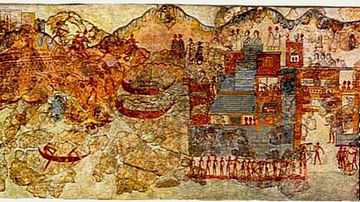
Ship Procession Fresco, Akrotiri
Bronze Age fresco of a ship procession from Akrotiri on the Aegean island of Thera (modern-day Santorini). From Room 5 of the West House, c. 2000-1500 BCE. (National Archaeological Museum, Athens)

Image
Minoan 'Procession Fresco' from Knossos
Part of the reconstructed 'Procession Fresco' from Knossos showing five men walking to the right and carrying ceremonial vessels. They are dressed in kilts while their arms and legs are decorated with jewellery...
