
Search
Did you mean: Urbanization?
Remove Ads
Advertisement
Search Results

Article
The Role of Workers' Soviets in the Russian Revolutions
Soviets, often called Soviets of Workers' Deputies, were worker councils first formed during the Russian Revolution of 1905 when a general strike was called against the Tsarist regime. Factory and other types of workers across the newly industrialised...

Article
Scythian Territorial Expanse
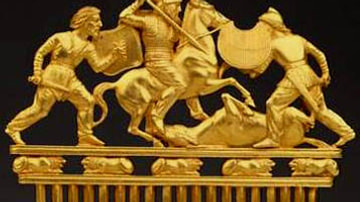
With 7600 perimeter miles (12,231 km), the Scythians roamed and ruled over an astonishing 1.5 million mi² (2.4 million km²) of territory between the 7th and 3rd centuries BCE. Although building an empire was never in their interest, Scythian...

Article
Dogs & Their Collars in the Age of Enlightenment - From "Machines" to Pampered Pets
In medieval and Renaissance Europe, dogs were considered little more than "machines" which performed certain tasks, such as guarding a home or tracking game, but this view changed significantly during the Age of Enlightenment (also known...
Article
Parthian-Scythian Relations
While little is written about Parthian-Scythian relations, not only did the Parthians share origins with the Scythians and cooperated militarily but social, cultural, and commercial interactions were likely as well. Essentially leading a...

Article
Indigenous Intercultural Health in Chile
Since the return to democracy in Chile in 1990 CE, the new governments have dealt with one of the great historical debts of the Chilean state, its relationship with the indigenous peoples. These peoples have been historically marginalized...

Article
W. M. Mitchell's The Underground Railroad - A Firsthand Account of the Struggle for Freedom
William M. Mitchell (circa 1826 to circa 1879) was a free-born Black overseer in North Carolina who, after 12 years managing slaves on a plantation, experienced a religious awakening, condemned slavery, left North Carolina for Ohio, and became...

Interview
Interview: Metsamor Archaeological Site
Metsamor, which is located 32 km (20 mi) west of Yerevan, Armenia is one of the most interesting archaeological sites in the Caucasus. While first settled and founded as a Bronze Age city, people continuously inhabited Metsamor through Urartian...

Article
Traveling Classroom History Exhibit
The best way to learn ancient history is not by memorizing dates and facts but, rather, through critical thinking and analysis. When studying ancient history, the key is to make inferences, using empathy and evaluation to alter one's perspective...

Collection
The Ancient Egyptians
This collection examines the economic, social, political, and cultural organization of ancient Egypt from the Predynastic Period to the Third Intermediate Period. It provides supplementary materials to students who want to enhance their history...

Definition
Indus Valley Civilization
The Indus Valley Civilization was a cultural and political entity which flourished in the northern region of the Indian subcontinent between c. 7000 - c. 600 BCE. Its modern name derives from its location in the valley of the Indus River...
