
Search
Remove Ads
Advertisement
Search Results
Article
Olive Branch Petition
The Olive Branch Petition was a letter adopted by the Second Continental Congress on 5 July 1775 and sent to King George III of Great Britain (r. 1760-1820) in a final attempt at reconciliation in the early months of the American Revolutionary...

Article
The Olive in the Ancient Mediterranean
Olives and olive oil were not only an important component of the ancient Mediterranean diet but also one of the most successful industries in antiquity. Cultivation of the olive spread with Phoenician and Greek colonization from Asia Minor...
Image
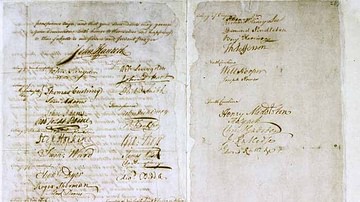
Signature Page of the Olive Branch Petition
The signature page of the Olive Branch Petition of 5 July 1775, the last attempt made by the Second Continental Congress to avoid a war with Great Britain. This is a scan of an original photo from the US Library of Congress.

Definition
Indo-European Languages
The Indo-European languages are a family of related languages that today are widely spoken in the Americas, Europe, and also Western and Southern Asia. Just as languages such as Spanish, French, Portuguese and Italian are all descended from...

Definition
Second Continental Congress
The Second Continental Congress was the body of delegates that governed the Thirteen Colonies and, later, the United States during the American Revolutionary War. Between its first session in May 1775 and its disbandment in March 1781, the...

Image
Trapetum Roman Olive Press
A Roman stone olive press known as a trapetum. From Pompeii. The device consisted of a large stone bowl (mortarium) into which the olives were poured and then crushed under two concave stones (orbes) attached to a central beam (cupa) fixed...

Image
Olive Press Stone
A stone from an olive press used to collect the oil from the pressed olives and pour it into a waiting receptacle. 6th-2nd century BCE, Saint Blaise, France.
Image
Olive Grove
An olive grove on the Greek island of Corfu.
Image
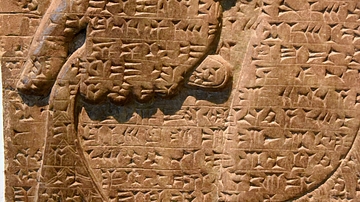
Flowering Branch Held by an Apkallu, Panel 1
Alabaster bas-relief detail showing an Apkallu holding a flowering branch. Neo-Assyrian Period, 865-860 BCE. Detail of Panel 1, Door A, Room F, the North-West Palace at Nimrud, modern-day Iraq. (The British Museum, London)
Image
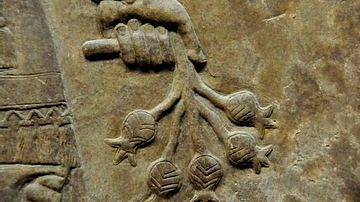
Flowering Branch Held by an Apkallu, Panel 2
Alabaster bas-relief detail showing an Apkallu holding a flowering branch. Neo-Assyrian Period, 865-860 BCE. Detail of Panel 2, Room Z, the North-West Palace at Nimrud, modern-day Iraq. (The British Museum, London)
