
Search
Search Results

Definition
Babylon - The Gate of the Gods
Babylon is the most famous city from ancient Mesopotamia, whose ruins lie in modern-day Hillah, Iraq, 59 miles (94 km) southwest of Baghdad. The name is derived from bav-il or bav-ilim, which in Akkadian meant "Gate of God" (or "Gate of the...

Definition
Elam - The Ancient High Country
Elam was a region in the Near East corresponding to the modern-day provinces of Ilam and Khuzestan in southern Iran (though it also included part of modern-day southern Iraq) whose civilization spanned thousands of years from circa 3200 to...

Definition
Coup of 18 Brumaire
The Coup of 18 Brumaire (9-10 November 1799) was a bloodless coup d'état in France that overthrew the government of the French Directory and replaced it with the French Consulate. The coup brought Napoleon Bonaparte to power and, in the view...

Definition
Assur
Assur (also Ashur, Anshar) is the god of the Assyrians who was elevated from a local deity of the city of Ashur to the supreme god of the Assyrian pantheon. His attributes were drawn from earlier Sumerian and Babylonian deities and so he...
Definition
Ashurnasirpal II
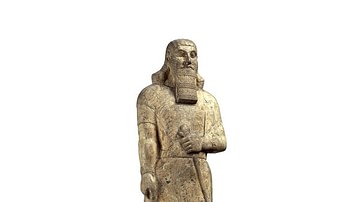
Ashurnasirpal II (r. 884-859 BCE) was the third king of the Neo-Assyrian Empire. His father was Tukulti-Ninurta II (r. 891-884 BCE) whose military campaigns throughout the region provided his son with a sizeable empire and the resources to...

Article
The Greatest Party Ever Thrown: Ashurnasirpal II’s Kalhu Festival
The greatest party ever thrown in antiquity is the inaugral event thrown by Ashurnasirpal II (r. 884-859 BCE) in 879 BCE at the completion of his new city of Kalhu which was attended by almost 70,000 people who were served, among other treats...

Definition
Nineveh - The Great Cultural Center That Became the "City of Sin"
Nineveh (modern-day Mosul, Iraq) was one of the oldest and greatest cities in antiquity. It was originally known as Ninua, a trade center, and would become one of the largest and most affluent cities in antiquity. It was regarded highly by...

Definition
Ninurta
Ninurta (identified with Ningirsu, Pabilsag, and the biblical Nimrod) is the Sumerian and Akkadian hero-god of war, hunting, and the south wind. He first appears in texts in the early 3rd millennium BCE as an agricultural god and local deity...

Article
12 Great Cities of Ancient Mesopotamia - The Rise and Fall of the Earliest Cities in the World
The great cities of Mesopotamia ("the land between two rivers") developed prior to the late 4th millennium BCE along two rivers – the Tigris and Euphrates – and were fully established by the Early Dynastic period (circa 2900 to circa 2350/2334...

Definition
Marduk
Marduk was the patron god of Babylon who presided over justice, compassion, healing, regeneration, magic, and fairness, although he is also sometimes referenced as a storm god and agricultural deity. His temple, the famous ziggurat described...
