
Search
Search Results

Definition
Medes
The Medes or Medians were a group of Indo-Iranian-speaking people from central Asia who migrated westwards and entered northern Iran around the end of the 2nd millennium BCE. They settled in the highlands of Zagros (Zagreus in Greek) and...

Definition
Ashur - The First Great Assyrian City
Ashur (also known as Assur) was an Assyrian city located on a plateau above the Tigris River in Mesopotamia (today known as Qal'at Sherqat, al-Shirqat District, northern Iraq). The city was an important center of trade, as it lay squarely...
![Moabite Stone [Mesha Stele]](https://www.worldhistory.org/img/c/p/360x202/10037.jpg?v=1747932305)
Definition
Moabite Stone [Mesha Stele]
The Moabite Stone, otherwise known as the Mesha Stele, contains an ancient inscription by Mesha, King of Moab during the late 9th century BCE, elements of which match events in the Hebrew Bible. The inscription describes two aspects of how...

Definition
Assyrian Warfare
Assyria began as a small trading community centered at the ancient city of Ashur and grew to become the greatest empire in the ancient world prior to the conquests of Alexander the Great and, after him, the Roman Empire. While the Assyrians'...
Definition
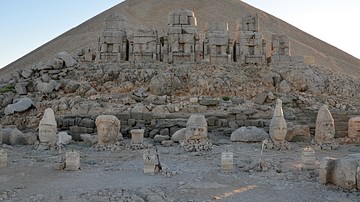
Commagene
The Kingdom of Commagene (163 BCE - 72 CE) was a Hellenistic political entity, heavily influenced by Armenian and ancient Persian culture and traditions, established in southwestern Anatolia (modern-day Turkey) by Ptolemaeus of Commagene...

Definition
Sargonid Dynasty
The Sargonid Dynasty was the last ruling house of the Neo-Assyrian Empire from 722-612 BCE, beginning with the reign of Sargon II and ending with fall of the Neo-Assyrian Empire. Some of the most famous kings in the history of Assyria come...

Definition
Gezer
Gezer is an ancient city and archaeological site located in central Israel where the central mountains meet the northern Shephelah, about 10 km southeast of the city of Ramleh. According to the Hebrew Bible, Gezer was one of the great cities...

Image
Assyrian Lion Hunt Relief
Frieze depicting a lion hunt, from the royal palace of Ashurbanipal, Nineveh, modern-day Iraq. Neo-Assyrian Empire, 668-631 BCE. The king's role was to protect his people from enemies. In ancient Assyria, this was symbolized in the lion...

Image
Lion-Hunting Scene, King Ashurbanipal
Sculpted relief illustrating the sporting exploits of the last great Assyrian king, Ashurbanipal, North Palace, room C, panel 20-22, Nineveh, modern-day northern Iraq. Neo-Assyrian Empire, reign of King Ashurbanipal, 668-631 BCE. In ancient...

Image
Assyrian Soldiers Holding Decapitated Heads of Nubian Soldiers
Detail of a large gypsum wall panel, depicting the Assyrian attack on a fortress at the Egyptian city of Memphis in 667 BCE, Panel 17, Room M of the North Palace at Nineveh, Northern Mesopotamia, modern-day Iraq, Neo-Assyrian Empire, 645-635...
