
Search
Remove Ads
Advertisement
Search Results
Image
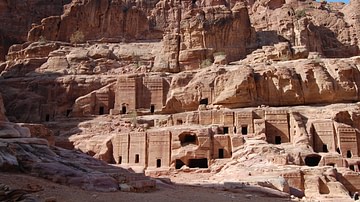
Petra Panorama
The Kingdom of Nabatea was a powerful political entity that flourished in the region of modern-day Jordan between the 4th century BCE and c. 106 CE and is best known today for the ruins of its capital city, Petra. Precisely when...
Image
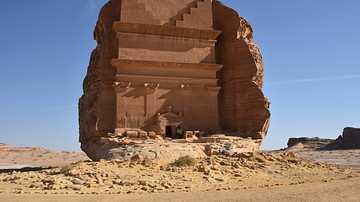
Tomb of the Lion of Kuza, Hegra
The Tomb of the Lion of Kuza (Qasr al-Farid) is a 1st-century CE Nabatean unfinished tomb carved into a single huge rock in Hegra (Madain Saleh) in Saudi Arabia, the Kingdom of Nabatea's second capital after Petra...
Image
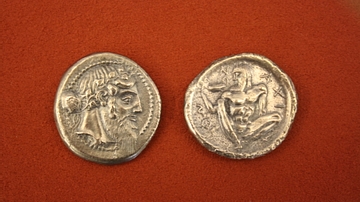
Naxos Silver Tetradrachm
Silver tetradrachm from Naxos, Sicily, c. 460 BCE. O: Head of Dionysos. R: Ithyphallic Silenos holding a cantharus.

Image
Renaissance Tomb in Petra
The so-called Renaissance Tomb, located in the Wadi Farasa in Petra (Jordan), has an elegant façade evoking elements of Italian Renaissance architecture, hence its name. The tomb façade consists of a triangular pediment...
Image
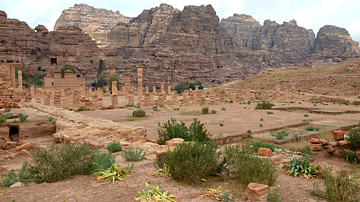
Petra Garden-Pool Complex
The garden and pool complex in Petra (Jordan) is an ornamental Nabataean garden situated on an artificial terrace west of the Great Temple and overlooking the main colonnaded street. It includes a large swimming pool...
Image
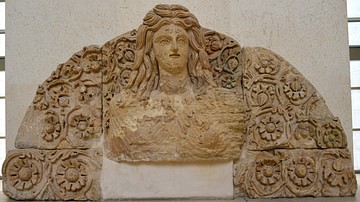
Nabataean Relief Sculpture of Atargatis
Stone sculpture of Atargatis (Ataratheh), the Syrian goddess of fertility in Classical antiquity, from the entrance of a Nabataean temple in modern-day southern Jordan. The Kingdom of Nabatea became prosperous...
Image
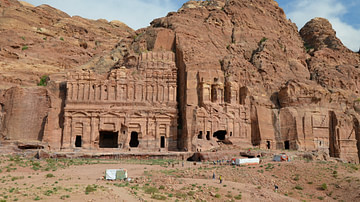
Nabataean Tombs of Petra
View of the Royal Tombs at Petra (Jordan). From left to right: the Palace Tomb with three distinct stories; the Corinthian Tomb and the Silk Tomb. 1st century CE.
Image
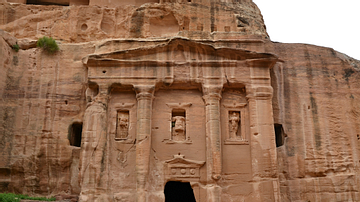
Nabataean Rock-cut Tomb in Petra
The Tomb of the Soldier in Petra (Jordan), carved out of the red sand stone with niches containing male figures dressed in military style. The tomb was built in the Nabataean period around the second half of the 1st...

Image
The Monastery in Petra
The Monastery is one of the largest monuments in Petra, Jordan. It is a monumental building carved out of the rock in the Nabataean Classical style. It was probably built as a temple in the early 2nd century CE, during the...
Image
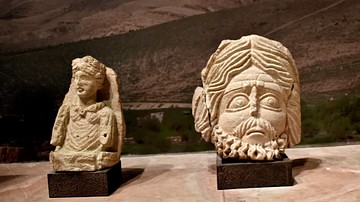
Atarghatis and Hadad from Khirbet et-Tannur
Atarghatis is seated on a throne and a large head of the bearded Hadad, sculpted in limestone in the Oriental Syrian style, is beside her. Both came from a group of sculptures that decorated and adorned the...
