
Search
Remove Ads
Advertisement
Search Results
Image
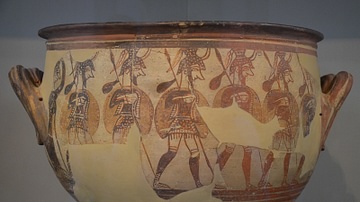
Mycenaean Krater With Warriors
Large Mycenaean krater depicting men in full armour (helmet, cuirass, greaves, shield and spear) as they depart for war, a sack of supplies hanging from their spears. To the side a woman raises her hand in a farewell...

Definition
Uluburun Shipwreck
The Uluburun shipwreck is a Bronze Age vessel discovered lying off the coast of Kas, Turkey. The ship, probably originally from Phoenicia/Canaan, dates to between 1330 and 1300 BCE and was carrying a full cargo of trade goods...

Image
Mycenaean Lion Rhyton
A gold rhyton in the form of a lion's head. From Grave Circle A, Mycenae, 16th century BCE. (National Archaeological Museum, Athens)

Image
Mycenaean Shield Fresco
A fragment from a fresco from the acropolis of Mycenae depicting the typical figure-of-eight shield design. 15th century BCE. (National Archaeological Museum, Athens)
Image
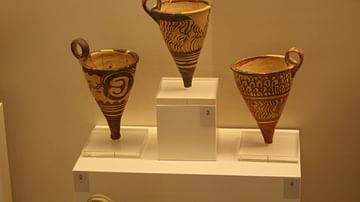
Mycenaean Rhyta
Three conical shaped rhyta (1500-1450 BCE) Mycenae area, Nafplio Archaeological Museum.

Video
Ancient Greek Pottery: History, Development and Designs
Ancient Greek pottery was for practical use, so once physical shapes of different types of pottery had been perfected for a particular purpose, the shape was maintained and copied. Greek pottery...

Article
Korean Celadon Pottery
The celadon (or greenware) ceramics produced in ancient Korea during the Goryeo Dynasty (918-1392 CE), are regarded as some of the finest and most elegant pottery pieces produced anywhere. With a pale green lustre reminiscent...
Image
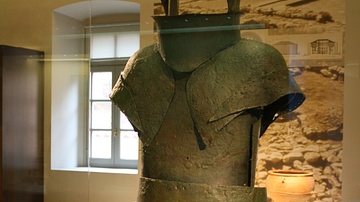
Mycenaean Bronze Armour
Bronze armour and boar tusk helmet (15th century BCE) from a mycenaean cemetery in Dendra. Nafplio Archaeological Museum.
Image
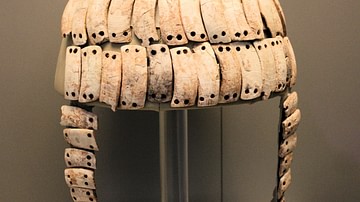
Mycenaean Boar's Tusk Helmet
Mycenaean boar's tusk helmet excavated from chamber tomb 515. A description of this type of helmet can be found in Homer's 'Iliad'. 14th - 13th cents. BCE. Currently housed at the National Archaeological Museum of Athens...

Image
Mycenaean Gold Sword Hilt
A Mycenaean gold sword hilt with bronze blade. From a tomb in Skopelos, 15th century BCE. (National Archaeological Museum, Athens)
