
Search
Remove Ads
Advertisement
Search Results

Video
The History of the Great Mughals, Babur to Aurangzeb | 1483 - 1707
The Mughal Empire ruled parts of the Indian Subcontinent for more than three centuries. In that time, it transformed India into what it is today. The Mughals came as outsiders from Central Asia who conquered India with steel and gunpowder...
Image
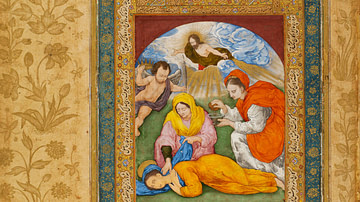
The Martyrdom of Saint Cecilia
The Life of Christ was commissioned by the third Mughal Emperor Akbar (1540-1605) to be translated into Persian. This was part of a larger effort to encourage inter-religious understanding and cooperation. The Martyrdom of Saint Cecilia...
Image
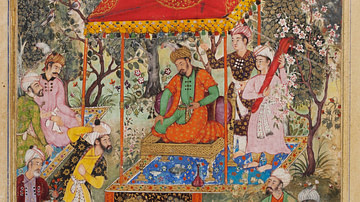
Folio from the Baburnama
Babur (1483-1540) who fled Ferghana in present day Uzbekistan to found the Mughal Empire in 1526, receives Uzbek and Rajput envoys. These envoys are offering their congratulations following Babur's accession to the throne. This is a detached...
Image
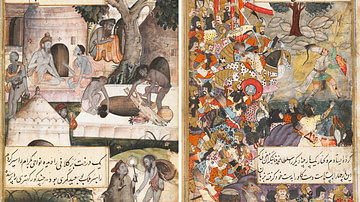
Two Folios from the Baburnama
Two detached folios from the Baburnama - the book of Babur which tells the life story of the Emperor Babur (1483-1530) who founded the Mughal Empire in 1526. The left folio shows ascetics at a shrine while on the right is a ceremony where...
Image
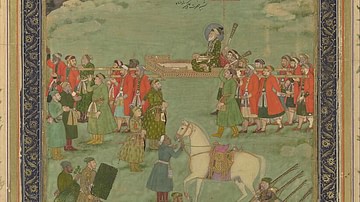
The Emperor Aurangzeb Carried on a Palanquin
A painting of Aurangzeb (1618-1707), sixth Mughal emperor. Here he is accompanied by a royal hunting party. The preparations for the hunt include several hunters in the foreground, camouflage screens, and a deer being led as a bait. The...
Image
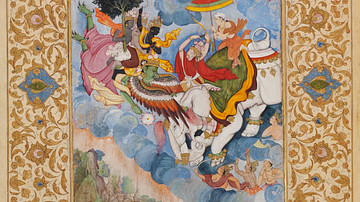
Folio from the Harivamsa
The third Mughal Emperor Akbar (1540-1605) sought to quell tensions between the Hindu and Muslim communities of Hindustan. Seeking to engender religious harmony and tolerance, he commissioned the translation of major Sanskrit texts into Persian...
Image
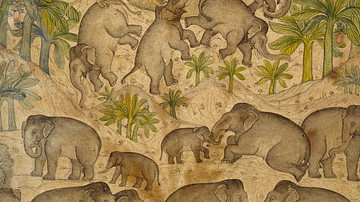
Elephants with Mythical Beasts
A Mughal painting showing mythical winged beasts surrounded by elephants. Line drawing with coloured wash, about 1610 – 20, Mughal. Museum no. IM.155-1914. © Victoria and Albert Museum, London
Image
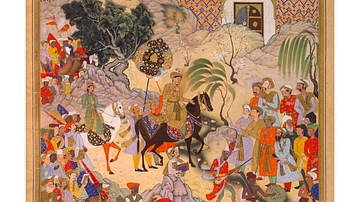
Folio from Akbarnama
The third Mughal Emperor Akbar's (1542-1605) triumphant entry into the city of Surat. A detached folio from a copy of the Akbarnama - the book of Akbar which chronicles his life and reign. Opaque watercolour and gold on paper, by Farrukh...
Image
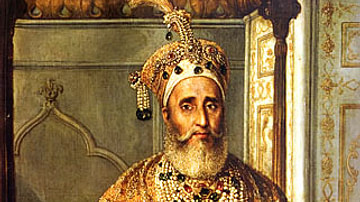
Bahadur Shah Zafar II
Bahadur Shah Zafar (1775-1862) was the twentieth Mughal Emperor of Hindustan. The Mughal Empire ended with him during the Sepoy Mutiny of 1857. Zafar was a celebrated poet and Sufi mystic who was exiled to Rangoon by the British East India...

Article
The Armies of the East India Company
The East India Company (EIC) was first England's and then Britain's tool of colonial expansion in India and beyond. Revenue from trade and land taxes from territories it controlled allowed the EIC to build up its own private armies, collectively...
