
Search
Did you mean: Solon?
Remove Ads
Advertisement
Search Results
Image
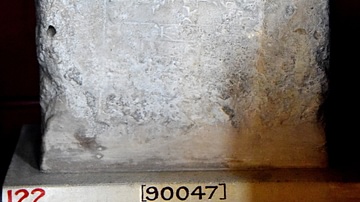
Mud Brick Stamped with the Name of Warad-Sin
This baked-mud brick was stamped with the name of king Warad-Sin, king of Larsa; reigned 1770-1758 BCE (short chronology) and possible co-regency with his father Kudur-Mabuk. The cuneiform inscriptions mention...

Video
Hecate the Goddess of Witchcraft and Magic in Greek Mythology
Hecate is the goddess associated with magic, witchcraft, the moon, doorways, the night, necromancy, and ghosts in Greek mythology. She is the goddess of boundaries, the guardian of crossroads...

Image
Metope of Helios in Quadriga
This was part of a marble architrave. The row of sculpted metopes on the north side of the temple to the goddess of the city of Ilion, Athena, began with an image of the sun god's Quadriga rising out of the sea. Like...
Image
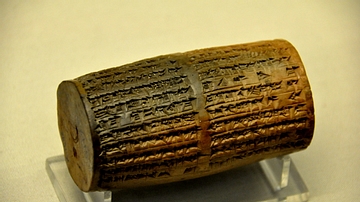
King Nabonidus Clay Cylinder from Ur
This clay document tells us how Nabonidus (the last king of Babylon) built and reconstructed the temple of Sin, the moon God, at Ur. It also mentions a prayer for the king and Beslshazzar, his son. From Ur, neo-Babylonian...
Image
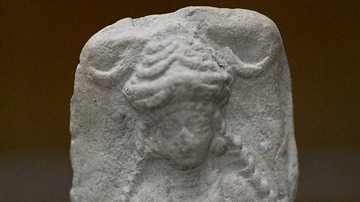
Seated Mesopotamian Goddess
Mesopotamian female deity wearing a horned headdress and sitting on a chair or a throne, probably goddess Ishtar or goddess Bau. The lunar symbol of the moon god Sin appears at the upper part, flanking the headdress...
Image
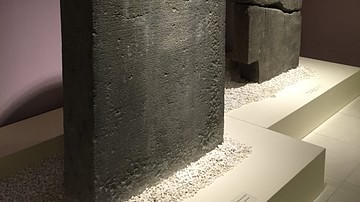
Tablets with King Nabonidus Inscriptions, Harran
These large tablets comes from the 6th-5th century BCE. They contain the inscriptions from King Nabonidus, who was the last king of the Neo-Babylonian Empire, reigning from 556–539 BC. These tablets were...
Image
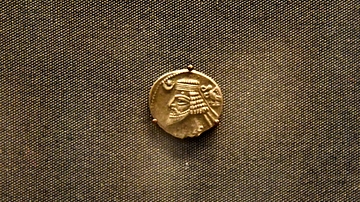
Silver Coin of Farhad IV
The Parthian "King of Kings " Farhad (Phraates) IV, reigned 38-2 BCE, is shown wearing a royal headband (diadem). Divine symbols of the moon crescent and star, and an eagle holding a royal headband, indicate that the king...

Video
Origin and History of the Ancient Olympic Games
The Olympic Games as we know them today began in April of 1896 in Athens, where the city welcomed 13 nations to compete, but this video is going way back to the year 776 BCE and it's going to explore the...

Image
A Stone Bowl with Two Inscriptions
This stone bowl has two sets of cuneiform inscriptions. The first one says that the bowl was booty brought to Mesopotamia from Magan (modern Sultanate of Oman) by the Akkadian king Naram-Sin (2254-2218 BCE). The...
Image
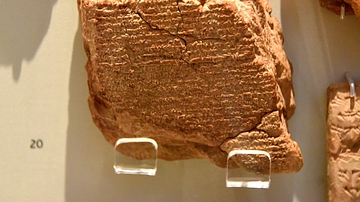
Tablet Observation of Halley's Comet
Babylonian astronomical diaries recorded daily observation of the moon and planets from around the 7th century BCE onward. The diaries for 164-163 BCE contain observations of Halley's comet at its 1st and last...
