
Search
Did you mean: Solon?
Remove Ads
Advertisement
Search Results

Definition
Yin and Yang
The principle of Yin and Yang from Chinese philosophy is that all things exist as inseparable and contradictory opposites. Examples of Yin-Yang opposite forces are female-male, dark-light, and old-young. The pairs of equal opposites...

Definition
Phoenician Religion
The Phoenician Religion, as in many other ancient cultures, was an inseparable part of everyday life. Gods such as Baal, Astarte, and Melqart had temples built in their name, offerings and sacrifices were regularly made to...
Definition
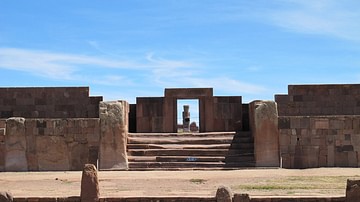
Tiwanaku
Tiwanaku (or Tiahuanaco) was the capital of the Tiwanaku empire between c. 200 - 1000 CE and is situated in the Titicaca basin. At an altitude of 3,850 metres (12,600 ft) it was the highest city in the ancient world and had a peak population...

Definition
Surya
Surya (also known as Aditya) is the Hindu god of the Sun. He is considered the creator of the universe and the source of all life. He is the supreme soul who brings light and warmth to the world. Each day he travels across the sky in...

Definition
Kofun Period
Following the Yayoi Period of Japan when farming and metalworking techniques were introduced from mainland Asia was the Kofun Period (c. 250 CE - 538 CE) where the religion of Shinto emerges from the beliefs of previous eras and...

Definition
Three Kingdoms Period in Korea
The Three Kingdoms Period of ancient Korea (57 BCE – 668 CE) is so-called because it was dominated by the three kingdoms of Baekje (Paekche), Goguryeo (Koguryo), and Silla. There was also, though, a fourth entity...

Definition
Cadmus
Cadmus is a Phoenician-born prince and the founder and king of Thebes in Boeotia in Greek mythology. He travelled to Greece from his home in Tyre in search of his sister Europa who had been kidnapped by Zeus. His rescue mission was abandoned...

Definition
Prince Shotoku
Prince Shotoku (574-622 CE) ruled as regent of Japan from 594 to 622 CE and is one of the most celebrated figures in all of Japanese history. The prince was a great supporter of Chinese culture and Buddhism, spreading both during...

Definition
To-ji
The To-ji Shingon Buddhist temple complex is located in Kyoto, Japan. Founded in 796 CE, its five-storey wooden pagoda is the largest in Japan, a symbol of the city, and listed as a National Treasure. The complex includes other examples...

Definition
Freyja
Freyja (Old Norse for 'Lady', 'Woman', or 'Mistress') is the best-known and most important goddess in Norse mythology. Beautiful and many-functioned, she features heavily as a fertility goddess stemming from her place in the Vanir family...
