
Search
Did you mean: Mosaic?
Remove Ads
Advertisement
Search Results
Definition
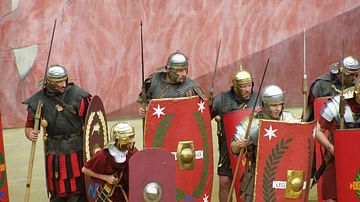
Legio I Adiutrix
Legio I Adiutrix was a legion of the Roman army formed from veteran sailors after the death of Roman emperor Nero (r. 54-68 CE). During its long career, the legion accompanied Trajan (r. 98-117 CE) on his Dacian and Parthian campaigns, fought...

Definition
Roman Auxiliary Cavalry
The Roman army consisted of three separate divisions: the famed legions, the cavalry, and lastly, the auxiliaries. The auxiliaries (auxilia) were comprised of infantry cohorts, mounted infantry, and cavalry units or wings (alae). Although...
Definition
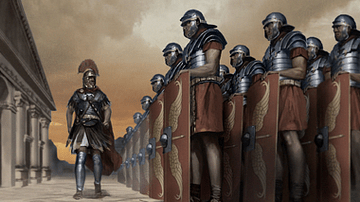
Legio V Alaudae
Legio V Alaudae, referenced in early accounts only as the "Fifth", was one of the many legions of the Roman army that helped Julius Caesar (100-44 BCE) to achieve success as a military commander in Gaul, Spain, and Africa. Later stationed...

Definition
Emperor Zeno
Zeno was Byzantine emperor from 474 until 491 CE. An ethnic Isaurian, Zeno was repeatedly criticized as an outsider during his reign, which was full of rebellions and attacks by the Ostrogoths. He is best known for his failed attempt to compromise...

Definition
Gallienus
Gallienus was Roman emperor from 253 to 268 CE. Publius Licinius Egnatius Gallienus, the eldest son of Emperor Valerian, was named co-emperor by his father in 253 CE. He was one of many who would claim the throne over the next two decades...
Definition
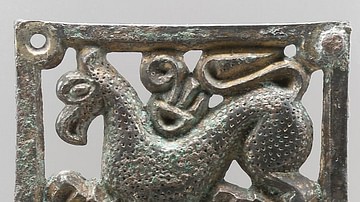
Bayan I
Bayan I (reigned 562/565-602 CE) was a king of the Avars, a confederation of heterogeneous people who migrated from the region of Mongolia, north of China, in 552 CE and came in contact with the Eastern Roman Empire c. 557 CE. Bayan I is...
Article
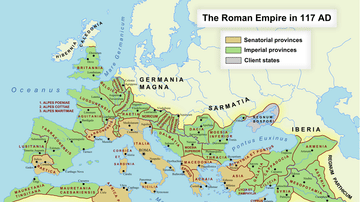
The Extent of the Roman Empire
Time has seen the rise and fall of a number of great empires - the Babylonian, the Assyrian, the Egyptian, and lastly, the Persian. Regardless of the size or skill of their army or the capabilities of their leaders, all of these empires fell...

Article
The Battle of the Catalaunian Fields
The Battle of the Catalaunian Fields (also known as The Battle of Chalons, The Battle of Maurica) was one of the most decisive military engagements in history between the forces of the Roman Empire under Flavius Aetius (391-454 CE) and those...

Article
Periplus of the Euxine Sea
The Periplus of the Euxine Sea (Circumnavigation of the Black Sea) is a description of trade routes along the shores of the Black Sea written by Arrian of Nicomedia (Lucius Flavius Arrianus), a historian and philosopher writing in the early...

Article
The Isaurians and the End of Germanic Influence in Byzantium
Germanic influence reigned in the Roman Empire from the end of the 4th century CE through the 5th. Germanic individuals took important posts in the government and the military, and Germanic tribes penetrated ever further into lands that had...
