
Search
Remove Ads
Advertisement
Search Results

Definition
Homo Rudolfensis
Homo rudolfensis is an early human species that lived in East Africa between c. 2.5 and 1.8 million years ago. It is known from a handful of skull, jaw and teeth fragments that remind alternatingly of Homo or of Australopithecus...

Definition
Ancient Korea
Korea, located on a large peninsula on the eastern coast of the Asian mainland, has been inhabited since Neolithic times. The first recognisable political state was Gojoseon in the second half of the first millennium BCE. From the...

Definition
Roman Architecture
Roman architecture continued the legacy left by Greek architects and the established architectural orders, especially the Corinthian. The Romans were also innovators and they combined new construction techniques and materials...

Definition
Oldowan Tools
The appearance of simple stone tools, widely known as Oldowan tools or the Oldowan industry, marked the beginning of our technological revolution. To our knowledge, these artifacts appeared around 2.6 million years ago in the savannahs...

Definition
Djoser
Djoser (also known as Netjerikhet, Tosorthos, and Sesorthos, c. 2670 BCE) was the first king of the Third Dynasty of Egypt, reigning for over twenty years. Some sources indicate a king named Sanakht as the first ruler of the Third Dynasty...

Definition
Ceide Fields
The Ceide Fields, near Ballycastle, Co. Mayo, on the western coast of Ireland, are recognised as one of the oldest and largest Stone Age farming sites in the world, dating back to c. 3700 BCE. The walls that have been discovered...

Definition
Solomon
According to biblical tradition (and some say myth), King Solomon was the third and last king in the ancient United Kingdom of Israel. Other faiths, such as Islam and Rastafarianism, also embrace the notion of Solomon as a sagacious...

Definition
Inca Architecture
Inca architecture includes some of the most finely worked stone structures from any ancient civilization. Inca buildings were almost always practical and pleasing to the eye. They are also remarkably uniform in design with even...

Image
Aztec Sun Stone
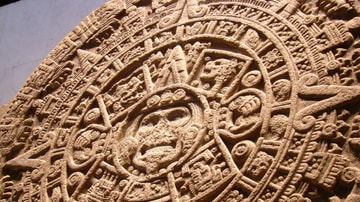
The Aztec Sun Stone (also known as the Calendar Stone) is a representation of the five eras of the sun from Aztec mythology. The stone was part of the architectural complex of the Temple Mayor of Tenochtitlán and dates to c. 1427...
Image
Tonatiuh, Calendar Stone
The Aztec Sun Stone (also known as the Calendar Stone) is a representation of the five eras of the sun from Aztec mythology. Some scholars consider the central face to be that of Tonatiuh, the sun god, while others maintain...
