
Search
Remove Ads
Advertisement
Search Results

Article
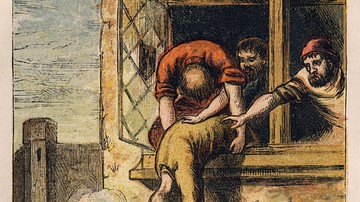
Passing of Philosophy to Religion: The Death of Hypatia
The death of the philosopher Hypatia of Alexandria (l. c. 370-415) has long been considered the "passage of philosophy to religion", exemplifying the transition from the pagan values of antiquity to those of the new religion of Christianity...
Article
Death of Admiral Coligny
The assassination attempt on Gaspard II de Coligny, Admiral of France (l. 1519-1572) on 22 August 1572 was the spark igniting the St. Bartholomew's Day Massacre beginning on 24 August and continuing in Paris for the next five days and elsewhere...

Worksheet/Activity
Importance of Geography in Medieval Japan
This activity has been designed to fit a 30-minute slot for your class and is suitable for both online and classroom teaching, as well as homeschooling. Students have to complete a map of medieval Japan and answer some questions about Japan's...

Worksheet/Activity
Arts & Culture in Medieval Japan
This activity has been designed to fit a 30-minute slot for your class and is suitable for both online and classroom teaching, as well as homeschooling. Students have to read three articles (also available in an audio format) on the three...

Article
Plagues of the Near East 562-1486 CE
Disease has been a part of the human condition since the beginning of recorded history – and no doubt earlier – decimating populations and causing widespread social upheaval. Among the worst infections recorded is the plague which is fairly...

Article
Death, Burial & the Afterlife in the Ancient Celtic Religion
The ancient Celts who occupied large parts of Europe from 700 BCE to 400 CE displayed a clear belief in an afterlife as evidenced in their treatment of the dead. In the absence of extensive written records by the Celts themselves, we are...

Image Gallery
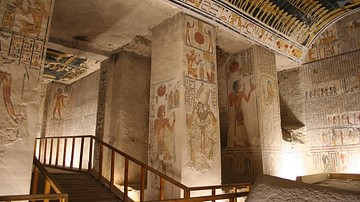
A Gallery of Death and the Afterlife in Ancient Egypt
Death in ancient Egypt was understood as a transition of the soul from the earthly plane to the afterlife, a rebirth, not a conclusion. After death, the soul passed through judgment by the god Osiris and, if justified by a life well-lived...

Image Gallery
The Lady and the Unicorn: Medieval Tapestries
The Lady and the Unicorn tapestries, housed at the Musée de Cluny in Paris, are a series of six exquisite medieval tapestries that are renowned for their beauty, craftsmanship, and mysterious symbolism. These tapestries are believed to have...

Article
Yellow Hair: George Armstrong Custer
Yellow Hair: George Armstrong Custer is the Cheyenne and Arapaho account of Lt. Colonel George Armstrong Custer (l. 1839-1876), his interaction with the Southern Cheyenne Chief Black Kettle (l. c. 1803-1868), the Washita Massacre (27 November...
Collection
Death and the Afterlife in the Ancient World
Belief in an afterlife was common in the ancient world, as it is today, and each culture created its own unique vision of the land that existed beyond the grave. Even with their differences, there are many similarities, including a concept...
