
Search
Remove Ads
Advertisement
Search Results

Image
Knossos Palace, Crete - Reconstruction
The palace of Knossos, was constructed c. 1700 BCE. In addition to its political function, it was perhaps also designed as an economic and religious centre for the Minoan civilization. Knossos was destroyed for...
Image
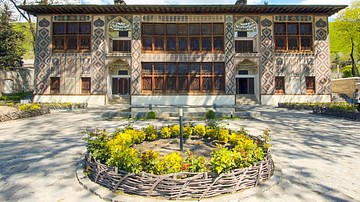
Palace of Shaki Khans
The Palace of Shaki Khans, built in 1797 by Muhammed Hasan Khan, in Shaki, Azerbaijan.

Image
Colossal Statue of a Winged Lion from the North-West Palace of Ashurnasirpal II
Colossal statue of a winged lion from the North-West Palace of Ashurnasirpal II, Nimrud (ancient Kalhu), modern-day Iraq. Neo-Assyrian Empire, c. 883-859 BCE. This is one of...

Image
Main Entrance, Palace of the Masters, Rhodes
The main entrance to the Palace of the Masters of the Knights Hospitaller or Knights of Rhodes. 14th century CE.
Video
Hadrian: the imperial palace
Hadrian built himself a vast palace in the countryside, the villa Adriana in Tivoli about 30 kilometres east of Rome. It was a huge complex, designed to accommodate thousands of people. It was his administrative capital...

3D Image
The Aztec Templo Mayor of Tenochtitlan - 3D View
The Templo Mayor or Great Temple (called Hueteocalli by the Aztecs) dominated the central sacred precinct of the Aztec capital Tenochtitlan, which is present-day Mexico City, Mexico. Topped by twin temples...

Article
Eunuchs in Ancient China
Eunuchs were powerful political players in ancient Chinese government. Originating as trusted slaves in the royal household they were ambitious to use their favoured position to gain political power. Advising the emperor...

Article
Museums in the Ancient Mediterranean
Museums have been around much longer than one might think, but in the ancient world, they were principally institutions of research and learning rather than places to display artworks and artefacts, even if they...
Definition
Pertinax
Pertinax was Roman Emperor for three months in 193 CE and, as successor to Commodus, it was hoped that he would restore much needed sobriety to the office of emperor. However, the former teacher, as well as putting in order the affairs...

Definition
Constantine V
Constantine V, also known as Constantine the Dung-named by his enemies, was emperor of the Byzantine empire from 741 to 775 CE. He enjoyed military successes in the Middle East and Balkans but his reign is chiefly remembered for...
