
Search
Remove Ads
Advertisement
Search Results
Image
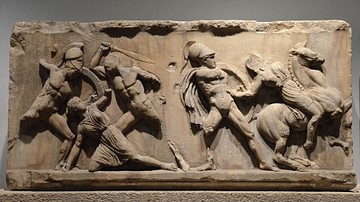
Amazonomachy Relief from the Mausoleum at Halicarnassus
Slab from the Amazonomachy frieze depicting five figures, three Greeks and two Amazons, and a horse. From the Mausoleum at Halicarnassus, around 350 BCE (British Museum).
Image
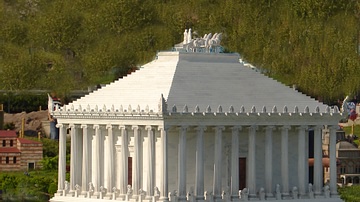
Model of the Mausoleum at Halicarnassus
A modern scale model of what the 4th century BCE Mausoleum at Halicarnassus may have looked like, one of the Seven Wonders of the world. (Miniatuk, Istanbul)

Image
The Centaur Frieze of the Mausoleum at Halicarnassus
This is a marble slab of the so-called Centaur frieze of the Mausoleum at Halicarnassus, also known as the Tomb of Mausolus. The whole frieze depicts a violent conflict between Greeks and Centaurs...
Image
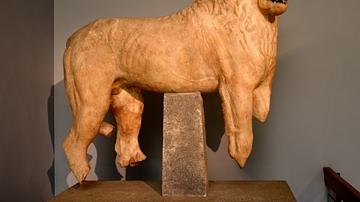
Marble Lion, Mausoleum at Halicarnassus
This is the most complete of the surviving lions from the Mausoleum at Halicarnassus, also known as the Tomb of Mausolus. The lions probably stood at the base of the stepped-pyramid roof, acting as both protective...

Definition
The Seven Wonders
The Seven Wonders of the Ancient World were seven impressive structures famously listed by ancient writers including Philo of Byzantium, Antipater of Sidon, Diodorus Siculus, Herodotus, Strabo, and Callimachus of Cyrene, among...

Article
Top 10 Archaeological Sites in Caria, Turkey
Located at the crossroads of many ancient civilizations, Turkey is a haven for archaeology lovers. Over the centuries, a succession of empires and kingdoms – Hittite, Lydian, Persian, Greek, Roman, Byzantine...
Image
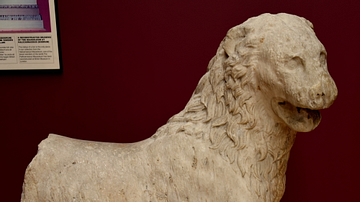
Statue of a Lion from Halicarnassus
This marble statue of a lion came from the Mausoleum at Halicarnassus, Bodrum, in modern-day Turkey. Late Classical Period, circa mid-4th century BCE. (Museum of Archaeology, Istanbul, Turkey).

Image
Theatre of Ancient Halicarnassus
The theatre of ancient Halicarnassus, built in the 4th century BCE during the reign of King Mausolos and enlarged in the 2nd century CE, the original capacity of the theatre was 10,000.

Definition
Sabratha
Sabratha was an ancient port city on the coast of North Africa (in modern-day Libya). The site was originally inhabited by the indigenous Berber Zwagha tribe in the 8th century BCE (according to the 11th-century CE historian al-Bakari...

Article
Philo of Byzantium's On the Seven Wonders
Philo of Byzantium's On the Seven Wonders (225 BCE) is the first known list of the Seven Wonders of the Ancient World (though it may have been based on earlier works now lost). Philo's list differs from the...
