
Search
Remove Ads
Advertisement
Search Results

Definition
Cleopatra Selene II
Cleopatra Selene II (40 - c. 5 BCE) was a member of the Ptolemaic Dynasty who became the queen of Mauretania upon her marriage to King Juba II of Numidia (48 BCE - 23 CE). Though more obscure than her famous mother, Cleopatra...

Definition
Glanum
Glanum, located near St-Rémy-de-Provence in southern France, was a Greek and then Roman town which prospered due to its location on trading routes between Italy and the Rhodanus (Rhone River). The town benefitted from a large building...
Definition
Callimachus of Cyrene
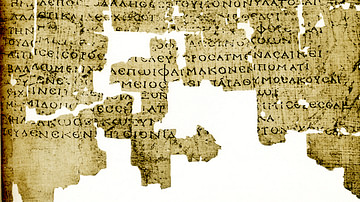
Callimachus of Cyrene (l. c. 310-c. 240 BCE) was a poet and scholar associated with the Library of Alexandria and best known for his Pinakes ("Tablets"), a bibliographic catalog of Greek literature, his poetry, and his literary...

Video
7 Wonders of the Ancient World
The seven wonders of the ancient world were: The Great Pyramid of Giza The Hanging Gardens of Babylon The Statue of Zeus at Olympia The Temple of Artemis at Ephesus The Mausoleum at Halicarnassus The Colossus...

Definition
Ancient Persian Governors
The Achaemenid Persian Empire functioned as well as it did because of the efficient bureaucracy established by its founder Cyrus the Great (r. c. 550-530 BCE) which was administered through the satrapy system. A Persian...

Definition
Artaxerxes II
Artaxerxes II (r. 404-358 BCE, also known as Artaxerxes II Mnemon) was the 10th monarch of the Achaemenid Empire (c. 550-330 BCE). He was the son of Darius II (r. 424-404 BCE) and Parysatis (who was Darius II's half-sister) and...

Definition
Augustus
Augustus Caesar (27 BCE - 14 CE) was the name of the first and, by most accounts, greatest Roman emperor. Augustus was born Gaius Octavius Thurinus on 23 September 63 BCE. Octavian was adopted by his great-uncle Julius Caesar in 44...

Article
The Royal Macedonian Tombs at Vergina
Excavations at Vergina in northern Greece in the late 1970s CE unearthed a cluster of tombs thought to be the burial site of Philip II (r. 359-336 BCE), the father of Alexander the Great (r. 336-323 BCE), with...

Definition
Byzantine Architecture
The architecture of the Byzantine Empire (4th - 15th century CE) continued its early Roman traditions but architects also added new structures to their already formidable repertoire, notably improved fortification walls and...

Definition
Tomb - Home of the Dead
A tomb is an enclosed space for the repository of the remains of the dead. Traditionally tombs have been located in caves, underground, or in structures designed specifically for the purpose of containing the remains of deceased...
