
Search
Did you mean: Cimon?
Remove Ads
Advertisement
Search Results
Image
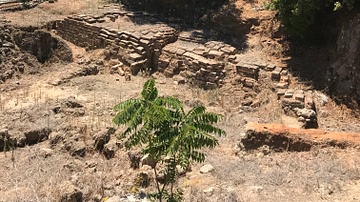
Lion Temple of Jaffa
The Lion Temple of Jaffa is located in the heart of Jaffa's old quarter in what is now present-day Israel. It dates to c. 1500 BCE – 1200 BCE when the region was occupied by ancient Egypt. It is believed that the Phoenician...

Image
Lion-Hunt Scene from Khorsabad
This survived alabaster bas-relief was found in Khorsabad (ancient Dar-Sharrukin, Mesopotamia, Iraq). An Assyrian king, probably Sargon II (r. 722-705 BCE), shoots an arrow and a lion (hit by another arrow) appears...
Image
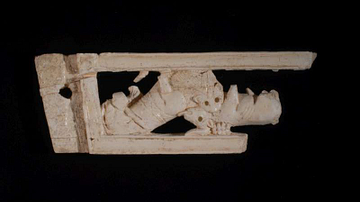
Lion & Bull in Combat Furniture Inlay
This object is an ivory furniture inlay depicting a lion and bull in combat. It was excavated from Samaria and dates to the Iron Age II (9th–8th Century BCE). (The Israel Museum, Jerusalem) Copyright of The Israel...

Image
Lion of Amphipolis
The Lion of Amphipolis, the monument to Laomedon of Mytilene, one of Alexander the Great's generals.
Erected: Late 4th century BCE
Location: Amphipolis, Macedonia, Greece

Image
Lion Pediment, Parthenon
A lion from the pediment of the Parthenon in the Museum of the Acropolis. Construction: 447-432 BCE
Image
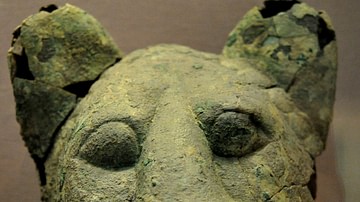
Lion's Head from the Temple of Ninhursag
Copper alloy head of a lion or cub, which may have acted as a guardian at the entrance to the Temple of Ninhursag at Tell Al-Ubaid, Southern Mesopotamia, modern-day Iraq. Early Dynastic Period, c. 2500 BCE...

Image
Lion-Columned Pathway, Kanchipuram
Covered pathway dotted with lion-pillars, Vaikuntanathaperumal Temple, Kanchipuram, India. 755-790 CE.

Image
Lion from the Mausoleum at Halicarnassus
One of the few free-standing sculptures from the Mausoleum at Halicarnassus, 4th century BCE. (British Museum, London)

Image
Lion Shaped Pitcher from Ancient Armenia
This clay pitcher with images of lions is made from clay. It comes from what is present-day Armenia, and it dates from the 13th century BCE. (Metsamor Historical-Archaeological Museum-Reserve, Taronik, Armenia...
Interview
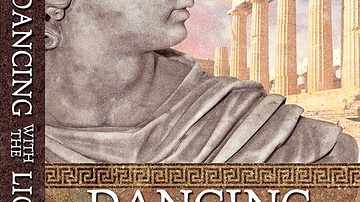
Interview: Jeanne Reames on Dancing with the Lion
Dr. Jeanne Reames' Dancing with the Lion: Becoming and Dancing with the Lion: Rise follow an epic tale of Alexander before he was “The Great.” In this interview, Dylan Campbell inquires about her passion...
