
Search
Did you mean: Cimon?
Remove Ads
Advertisement
Search Results

Image
Hercules & The Nemean Lion
This Attic vase shows Hercules wrestling the Nemean Lion in one of his 12 labours. Late 6th, early 5th century BCE. Athena looks on from the right.(Archaeological Museum, Milan).
Image
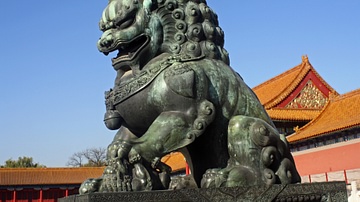
Chinese Lion-Dog
Bronze Lion-Dog (aka Foo-Dog) at the Forbidden City, Beijing, China. They are always placed in pairs; the male has a paw on an ornate ball, representing power and domination over the human affairs of the world while the female...

Image
Rampant Lion, Konarak Temple
This is a sculpture found in the Konarak Sun Temple, Odisha state, India. It shows a rampant lion standing upon a crouching elephant, the whole sculpture being supported on a pedestal. Though covered with plaster, the...
Image
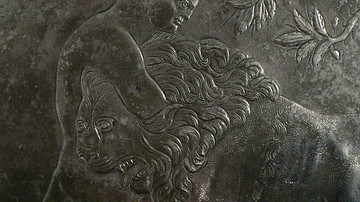
Hercules and the Nemean Lion
Heracles fighting the Nemean Lion. Silver missorium, 6th century CE (?) (Cabinet des Médailles, more formally known as Département des Monnaies, Médailles et Antiques de la Bibliothèque nationale de France, Paris, France...
Image
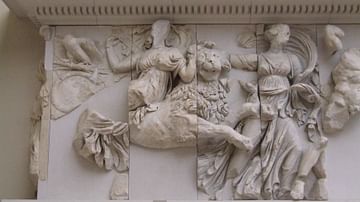
Rhea Riding a Lion
A scene from the Pergamon altar depicting the Titan Rhea riding a lion. 2nd century BCE. (Pergamon Museum, Berlin)

Image
Delos Lion Sculpture
A lion sculpture in marble from the island of Delos in the Greek Cyclades, 7th century BCE (this is a replica as the originals are now in the museum of Delos). Orignally nine or even as many as 16 lions lined an avenue in...
Image
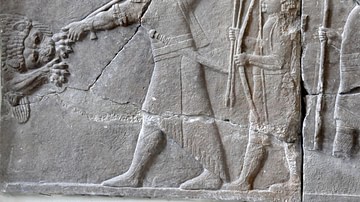
Assyrian Lion Hunt Relief, Nineveh
Gypsum wall relief depicting the typical royal hunting of lions, part of a longer sequence. The king, Ashurbanipal II, thrusts a spear onto a leaping and furious lion. Behind him, an Elamite squire assists him...

Image
Basalt Lion of Babylon (Statue)
The Lion of Babylon (أسد بابل), a stone sculpture found in the ancient city of Babylon, modern-day Iraq in 1876. It may have been built by either Nebuchadnezzar II (605-562 BCE) or the Hittites (notice the absence...

Image
Calligraphic Depiction of Ali as a Lion
Shiite calligraphy depicting Caliph Ali (r. 656-661 CE) as the Lion of God.
Image
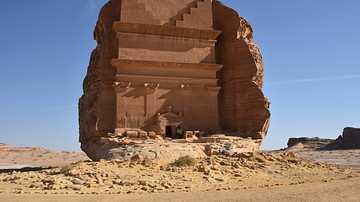
Tomb of the Lion of Kuza, Hegra
The Tomb of the Lion of Kuza (Qasr al-Farid) is a 1st-century CE Nabatean unfinished tomb carved into a single huge rock in Hegra (Madain Saleh) in Saudi Arabia, the Kingdom of Nabatea's second capital after Petra...
