
Search
Did you mean: Lugh?
Remove Ads
Advertisement
Search Results

Definition
Battle of Actium
The Battle of Actium (2 September 31 BCE, fought in the Ionian Sea off Actium, Greece) was the decisive engagement of the civil war fought between Octavian Caesar (l. 63-14 CE, later known as Augustus, r. 27 BCE - 14 CE) and the...

Definition
Little Crow (Eastman's Biography)
Little Crow (Taoyateduta, also known as Little Crow III, l. c. 1810-1863) was a Dakota Sioux chief best known as the leader of the Mdewakanton Dakota (Santee) Sioux during the Dakota War of 1862. After years of trying...
Definition
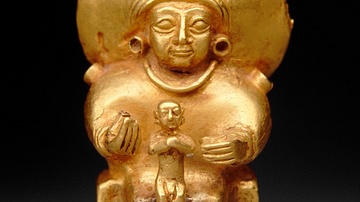
Sauska - The Hurrian's Radiant Goddess of Fertility and War
Sauska (also known as Shaushka, Sausga, and Anzili) was the Hurrian-Hittite goddess of fertility, war, and healing. She was worshipped throughout the region known as Hanigalbat (present day Iraq...

Definition
Hanuman
Hanuman is one of several zoomorphic characters in Indian mythology, but is the only wholly animal figure who is revered as a god today. The mythic texts speak of him as a monkey child of the Wind God, as possessing enormous strength...

Definition
Artemis
Artemis was the Greek goddess of hunting, wild nature, and chastity. Daughter of Zeus and sister of Apollo, Artemis was a patron of girls and young women, and a protectress during childbirth. Artemis was widely worshipped but her most...

Definition
Shapur I
Shapur I (r. 240-270 CE) is considered one of the greatest kings of the Sassanian Empire for expanding his realm, his policy of religious tolerance, building projects, and committing the Zoroastrian scriptures (Avesta) to writing. He...

Definition
Gilgamesh - The Historical and Mythical King
Gilgamesh is the semi-mythic King of Uruk, best known as the hero of The Epic of Gilgamesh (circa 2100 to circa 1200 BCE), the great Babylonian poem that predates Homer's Iliad and Odyssey by 1500 years and...
Definition
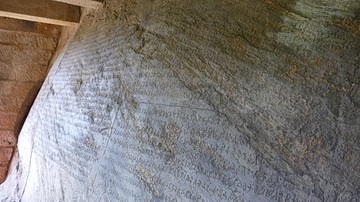
The Edicts of Ashoka the Great
The Edicts of Ashoka are 33 inscriptions engraved on pillars, large stones, and cave walls by Ashoka the Great (r. 268-232 BCE), the third king of the Mauryan Empire (322-185 BCE) of India. One set, the so-called Major...

Definition
Lugh
Lugh (also Lug, Luga) was one of the most important Celtic gods, particularly in Ireland, and he represented the sun and light. Although originating as an all-wise and all-seeing deity, Lugh was later thought of as a historical figure...

Definition
Gnosticism
Gnosticism is the belief that human beings contain a piece of God (the highest good or a divine spark) within themselves, which has fallen from the immaterial world into the bodies of humans. All physical matter is subject to decay...
