
Search
Did you mean: Kos?
Remove Ads
Advertisement
Search Results

Definition
Unified Silla Kingdom
The Unified Silla Kingdom (668- 935 CE) was the first dynasty to rule over the whole of the Korean peninsula. After centuries of battles with the other states of the Three Kingdoms Period (57 BCE - 668 CE) Silla benefitted from the help of...

Definition
Taejo of Goryeo
Taejo (r. 918-943 CE), previously known as Wang Geon or Wang Kon, was the founder and first king of the Goryeo (Koryo) kingdom which unified and ruled ancient Korea from 918 CE to 1392 CE. Wang Geon was given the posthumous title of Taejo...

Definition
Ancient Korea
Korea, located on a large peninsula on the eastern coast of the Asian mainland, has been inhabited since Neolithic times. The first recognisable political state was Gojoseon in the second half of the first millennium BCE. From the 1st century...
Definition
Samguk Yusa
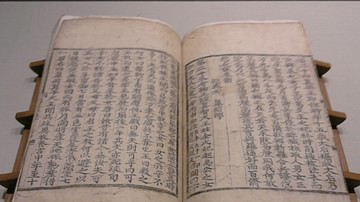
The Samguk yusa ('Memorabilia of the Three Kingdoms') is a 13th-century CE text which covers the history and legends of Korea's founding right up to the 10th century CE. It is a sequel of sorts to the earlier Samguk sagi ('Records of the...

Definition
Samguk Sagi
The Samguk sagi ('History of the Three Kingdoms' or 'Historical Records of the Three States') is a 12th-century CE text written by Gim Busik which is considered the first history of Korea. The text covers the history of Silla, Baekje (Paekche...

Definition
Later Three Kingdoms Period
The Later Three Kingdoms period (889-935 CE) of ancient Korea saw a partial revival of the old three kingdoms which had dominated the peninsula from the 1st century BCE to the 7th century CE. After the Unified Silla kingdom had ruled Korea...

Article
Korean Celadon Pottery
The celadon (or greenware) ceramics produced in ancient Korea during the Goryeo Dynasty (918-1392 CE), are regarded as some of the finest and most elegant pottery pieces produced anywhere. With a pale green lustre reminiscent of jade and...

Definition
Inca Religion
For the Incas, as with many other ancient cultures, religion was inseparable from politics, history, and society in general. All facets of community life were closely connected to religious beliefs, from marriages to agriculture, government...
Definition
Viracocha
Viracocha was the supreme god of the Incas. He is also known as Huiracocha, Wiraqoca and Wiro Qocha. Considered the creator god he was the father of all other Inca gods and it was he who formed the earth, heavens, sun, moon and all living...

Definition
Nihon Shoki
The Nihon Shoki ('Chronicle of Japan' and also known as the Nihongi) is an official history of Japan which was written by a committee of court scholars in 720 CE. It is a compilation of myths and legends concerning the Shinto gods and episodes...
