
Search
Remove Ads
Advertisement
Search Results

Image
St Canice’s Cathedral and Round Tower
St Canice’s Cathedral and Round Tower, Kilkenny. The monastic activity on the site is believed to have been established in the 6th century CE by Saint Canice, while the present church dates from the 13th century...

Definition
Krak Des Chevaliers
Krak des Chevaliers (also spelt Cracs des Chevaliers, and known in Arabic as Hisn al-Akrad) is a castle in Syria originally built for the Emir of Aleppo in 1031 CE but acquired and extensively rebuilt by the Knights Hospitaller...

Image
Knights in Armour, 15th century CE
Knights in armour typical of the 15th century CE. (Metropolitan Museum of Art, New York)

Image
Knights Hospitaller
An illustration of a priest and knight of the military order the Knights Hospitaller. 14th-15th century CE. (From a work in the Sacra Infermeria Museum, Valletta)

Image
Teutonic Knights Entering Marienburg Castle
A 19th century CE painting by Carl Steffeck depicting Teutonic knights entering the Prussian castle of Marienburg.

Image
Galahad Battles the Seven Knights of Darkness
"The seven knights of darkness" was painted c. 1893-1902 CE. The painting depicts the legendary Sir Galahad battling personifications of the Seven Deadly Sins as part of his quest for the Holy Grail. It...

Video
7 Misconceptions About Medieval Knights
7 Misconceptions about medieval knights Click Here To Subscribe! http://bit.ly/EliteFacts Follow us on googleplus: https://plus.google.com/+Elitefacts/posts Like us on Facebook: https://www.facebook.com/EliteFacts...

Article
The Siege of Acre, 1291 CE
The Siege of Acre in 1291 CE was the final fatal blow to Christian Crusader ambitions in the Holy Land. Acre had always been the most important Christian-held port in the Levant, but when it finally fell on 18 May 1291...
Image
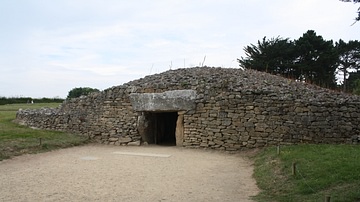
Table-des-Marchands Tumulus, Locmariaquer
The stone burial mound known as the Table-des-Marchands (Table of Merchants) at the Neolithic site of Locmariaquer in north-west France. The tomb was constructed in the 5th millennium BCE and is so called because...
Image
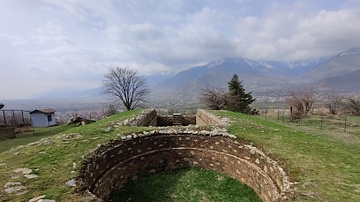
Round Apsidal Shrine, Harwan Monastery
An apsidal shrine made in diaper pebble masonry on the second terrace of the complex. From the Harwan Monastery in Kashmir, India.
