
Search
Did you mean: Japanese Castles?
Remove Ads
Advertisement
Search Results

Article
Visiting The Ruins of Lisbon’s Ancient and Medieval Past
Visiting the vibrant and colorful city of Lisbon, on the banks of the river Tagus and the edge of the Atlantic Ocean, what is most showcased is one episode of the city's and country's glorious past...

Definition
Château de Chenonceau
The Château de Chenonceau, picturesquely located astride the river Cher, in the Loire Valley town of Chenonceaux, France is a magnificent Renaissance-style building also known as le "Château des Dames" (the Ladies' Castle...

Definition
Khotyn Fortress
Khotyn fortress is a complex of fortifications situated on the hilly right bank of the Dniester in Khotyn, Ukraine. It consists of a 13th-century stronghold and an 18th-century bastion surrounding it. It is one of the oldest preserved...
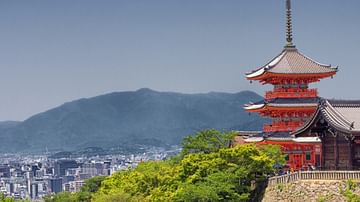
Image Gallery
A Gallery of Ancient Japanese Pagodas
In this gallery, we look at some of the most famous pagodas in Japan, many of which are classified as National Treasures. Pagodas are tall, multi-storied structures which traditionally featured as part of Buddhist...

Definition
Boeing B-29 Superfortress
The Boeing B-29 Superfortress was a four-engined, long-range bomber of the United States Air Force. The largest of all Second World War (1939-45) bombers, B-29s were used to strike Japanese targets from the summer of 1944...

Article
Ming Taxation & the Silver Economy
The rulers of China's Ming dynasty (1368-1644) acquired an insatiable desire for silver in the 16th century, largely to pay for huge prestige projects like building the Forbidden City in Beijing and repairing the...

Definition
Samurai
The samurai (also bushi) were a class of warriors that arose in the 10th century in Japan and which performed military service until the 19th century. Elite and highly-trained soldiers adept at using both the bow and sword, the samurai...
Image
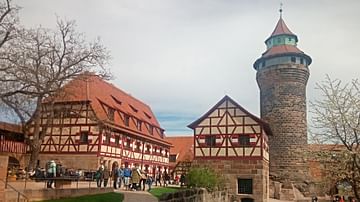
Nuremberg Castle
The Imperial Castle is Nuremberg's landmark, a symbol for the power and importance of the Holy Roman Empire. Nuremberg (Nürnberg), first documented as a royal estate in 1050, was an important base for the domestic power politics...

Article
Why Were Hiroshima & Nagasaki Bombed in WWII?
The decision to drop the atomic bomb in August 1945 was taken to avoid further Allied casualties in the Pacific War by forcing Japan into an immediate surrender. Another reason was, as the victors jostled...

Article
Daily Life in Medieval Japan
Daily life in medieval Japan (1185-1606 CE) was, for most people, the age-old struggle to put food on the table, build a family, stay healthy, and try to enjoy the finer things in life whenever possible. The upper classes...
