
Search
Did you mean: Assyria?
Remove Ads
Advertisement
Search Results
Image
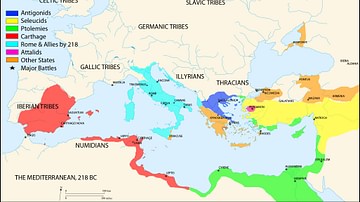
Map of the Mediterranean 218 BCE
A map of the Mediterranean in 218 BC, showing the territorial extents of the following states: - Antigonids - Attalids - Carthage - Ptolemies - Roman Empire - Seleucids Major battle locations are also shown...

Image
Map of the Illyrian Tribes
A map showing the Illyrian tribes prior to Roman conquest, including Phrygian tribes, Venetic tribes, independent tribes, and those under Celtic influence.

Image
Map of Europe in 220 BC
Approximate borders in Europe around 220 BC. Based on the Pengiun Atlas of History.
Image
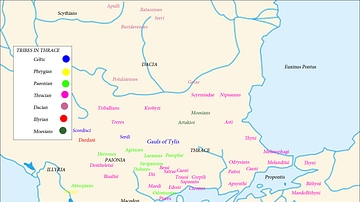
Map of the Tribes in Thrace
A map showing the major tribes in Thrace and the surrounding regions.
Image
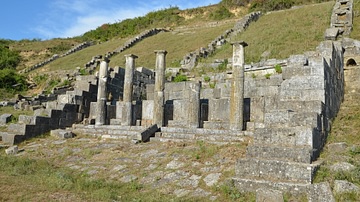
Nymphaeum at Apollonia, Albania
The rectangular basin of the Nymphaeum at Apollonia in Albania, fed by the underground water sources. 3rd century BCE. It is the biggest and best-preserved monument of Apollonia covering an area of 1,500 square metres...
Image
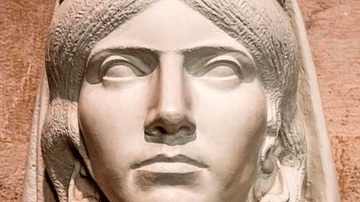
Queen Teuta
A modern bust of Teuta, the 3rd-century BCE queen of the Ardiaei, an Illyrian tribe. Teuta commanded fleets that were accused of piracy by the Romans, who sent a force to defeat her in 229/228 BCE.
Krujë, Albania.
Image
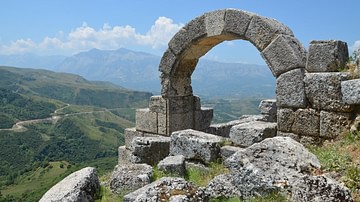
The Southeastern Gate of Amantia, Albania
The southeastern gate of Amantia in Albania, built in the first half of the 4th century BCE. Amantia, founded around the middle of the 5th century BCE, was the historical capital of the ancient Greek tribe...
Image
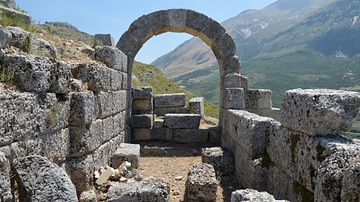
City Gate of Amantia, Albania
One of the city gates of Amantia with an archway belonging to the second phase of construction of the city. The city was protected by a 2,100 m long, walled enclosure equipped with three monumental gates.
Image
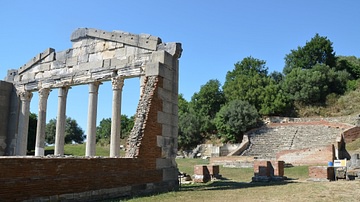
Agora of Apollonia, Albania
The north-western edge of the Agora of Apollonia in Albania with the Bouleterion, the Triumphal Arch and the Odeon.
Image
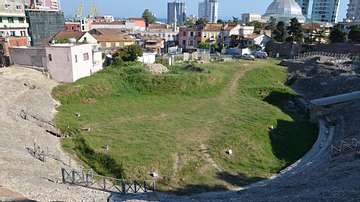
Amphitheatre of Durrës (Dyrrachium)
The Amphitheatre of Durrës (Roman Dyrrachium) in Albania was built in the 2nd century CE and held 15,000 to 20,000 people. It is among the largest monuments of antiquity to have survived on Albanian territory.
