
Search
Did you mean: Hanuman?
Remove Ads
Advertisement
Search Results

Definition
Huns
The Huns were a nomadic tribe prominent in the 4th and 5th century whose origin is unknown but, most likely, they came from "somewhere between the eastern edge of the Altai Mountains and the Caspian Sea, roughly modern Kazakhstan" (Kelly...
Definition
Chiusi
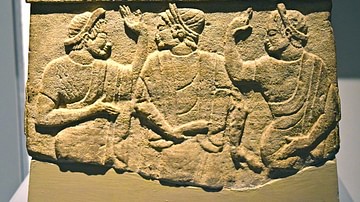
Chiusi (Etruscan name: Clevsin, Roman: Clusium), located in central Italy, was an important Etruscan town from the 7th to 2nd century BCE. Relations with the Romans famously soured when the king of Chiusi, Lars Porsenna, attacked Rome...

Definition
New Kingdom of Egypt - The Age of Empire
The New Kingdom (circa 1570 to circa 1069 BCE) is the era in Egyptian history following the disunity of the Second Intermediate Period (circa 1782-1570 BCE) and preceding the dissolution of the central government...

Definition
Knossos
Knossos (pronounced Kuh-nuh-SOS) is the ancient Minoan palace and surrounding city on the island of Crete, sung of by Homer in his Odyssey: “Among their cities is the great city of Cnosus, where Minos reigned when nine years old, he...

Definition
Amarna Period of Egypt
The Amarna Period of ancient Egypt was the era of the reign of Akhenaten (1353-1336 BCE), known as 'the heretic king'. In the 5th year of his reign (c. 1348 BCE), he issued sweeping religious reforms which resulted in the...

Definition
Salado Culture
The Salado culture is a term used by historians and archaeologists to describe a pre-Columbian Southwestern culture that flourished from c. 1200-1450 CE in the Tonto Basin of what is now the southern parts of the present-day US...

Definition
Philoctetes
The play Philoctetes was written by one of the greatest of the Greek tragedy playwrights, Sophocles, in 409 BCE. Philoctetes is one of his surviving plays whose exact production date can be determined and is set in the final year...

Definition
Avesta
The Avesta is the scripture of Zoroastrianism which developed from an oral tradition founded by the prophet Zoroaster (Zarathustra, Zartosht) sometime between c. 1500-1000 BCE. The title is generally accepted as meaning “praise”, though...
Definition
Benvenuto Cellini
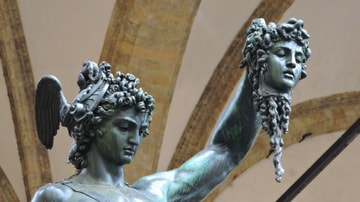
Benvenuto Cellini (1500-1571 CE) was an Italian Renaissance sculptor, medallist, and goldsmith whose most famous works today include the bronze statue of Perseus holding the head of Medusa, which now stands in Florence, and a...

Definition
Heimdall
Heimdall is a mysterious deity of Norse mythology whose main attribute refers to guarding the realm of the gods, Asgard, from his high fortress called Himinbjörg found at the top of Bifröst, the rainbow bridge. He has the might of sea...
