
Search
Did you mean: Hanuman?
Remove Ads
Advertisement
Search Results

Article
Why Japan's Kamikaze Attacks Failed in WWII
Kamikaze attacks were made by Japanese servicemen throughout the final, desperate year of the Second World War (1939-45). Planes, piloted rockets, and boats were packed with explosives with the intention...

Article
Angels in Ancient Judaism
The concept and function of angels in ancient Judaism were some of the many elements incorporated from contemporary cultures and religious views. The Hebrew malakh was translated into the Greek angelos, both of which indicated...

Article
William Harvey's Discovery of Blood Circulation
The human body's system of blood circulation was discovered by the English physician and anatomist William Harvey (1578-1657) in 1628. Harvey determined the relationship between the blood system of arteries...

Article
Xenophon's Defense of Socrates
Xenophon's Defense of Socrates (c. 371 BCE) is a passage from the Memorabilia of Xenophon (l. 430 to c. 354 BCE) in which he addresses the teachings and actions of Socrates of Athens and denounces the charges against...

Article
Procopius on the Plague of Justinian: Text & Commentary
The Plague of Justinian (541-542 CE and onwards) is the first fully documented case of bubonic plague in history. It is named for the emperor of the Byzantine Empire at the time, Justinian I (r...

Article
The Ideal of Christendom in Antiquity
The ideal of Christendom is a historical and political vision where society and government are unified under the Christian faith. According to this vision, power on Earth is divided between the church through...

Article
The Plague at Athens, 430-427 BCE
In the second year of the Peloponnesian War, 430 BCE, an outbreak of plague erupted in Athens. The illness would persist throughout scattered parts of Greece and the eastern Mediterranean until finally dying out...

Definition
Ares
Ares was the Greek god of war. He was perhaps the most unpopular of all the Olympian gods because of his quick temper, aggressiveness, and unquenchable thirst for conflict. Ares famously seduced Aphrodite, unsuccessfully fought with Hercules...

Definition
Eridu - The Divine Birthplace of Kingship and Order
Eridu (present-day Abu Shahrein, Iraq) was considered the first city in the world by the ancient Sumerians and is among the most ancient of the ruins from Mesopotamia. Founded circa 5400 BCE, Eridu...
Definition
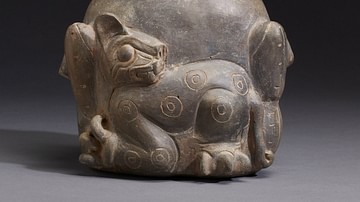
Chavin Civilization
The Chavin civilization flourished between 900 and 200 BCE in the northern and central Andes and was one of the earliest pre-Inca cultures. The Chavin religious centre Chavin de Huantar became an important Andean pilgrimage...
