
Search
Did you mean: Hanuman?
Remove Ads
Advertisement
Search Results

Definition
Woolly Mammoth
The woolly mammoth, Mammuthus primigenius, is an extinct herbivore related to elephants who trudged across the steppe-tundras of Eurasia and North America from around 300,000 years ago until their numbers seriously dropped from...

Definition
Temple at Uppsala
The Temple at Uppsala was a religious center dedicated to the Norse gods Thor, Odin, and Freyr located in what is now Gamla Uppsala in Sweden. It is described by the 11th-century historian Adam of Bremen as the most significant...

Definition
State of Nature
The state of nature is an idea which became especially popular with certain philosophers during the Enlightenment, notably Thomas Hobbes (1588-1679), John Locke (1632-1704), and Jean-Jacques Rousseau (1712-1778). It refers to...

Definition
Stone Age
From the dawn of our species to the present day, stone-made artefacts are the dominant form of material remains that have survived to today concerning human technology. The term “Stone Age” was coined in the late 19th century CE by...

Definition
Ancient India
India is a country in South Asia whose name comes from the Indus River. The name 'Bharata' is used as a designation for the country in their constitution referencing the ancient mythological emperor, Bharata, whose story is told...

Definition
Lao-Tzu
Lao-Tzu (l. c. 500 BCE, also known as Laozi or Lao-Tze) was a Chinese philosopher credited with founding the philosophical system of Taoism. He is best known as the author of the Laozi (later retitled the Tao-Te-Ching translated as “The...

Definition
Ancient Greek Religion
In the ancient Greek world, religion was personal, direct, and present in all areas of life. With formal rituals which included animal sacrifices and libations, myths to explain the origins of mankind and give the gods a...

Definition
Diogenes of Sinope
Diogenes of Sinope (l. c. 404-323 BCE) was a Greek Cynic philosopher best known for holding a lantern (or candle) to the faces of the citizens of Athens claiming he was searching for an honest man. He rejected the concept of...

Definition
Moses
Moses (c. 1400 BCE) is considered one of the most important religious leaders in world history. He is claimed by the religions of Judaism, Christianity, Islam, and Bahai as an important prophet of God and the founder of monotheistic belief...
Definition
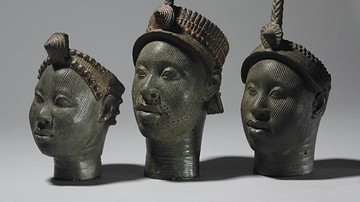
Ife
Ife (aka Ile-Ife) was an ancient African city which flourished between the 11th and 15th century CE in what is today Nigeria in West Africa. Ife was the capital and principal religious centre of the Yoruba kingdom of Ife, which prospered...
