
Search
Remove Ads
Advertisement
Search Results
Image
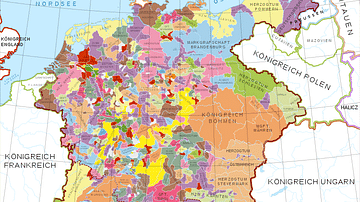
Holy Roman Empire in the 13th century CE
A map in German of central Europe during the time of the Hohenstaufen Emperors, primarily showing the territories of the Holy Roman Empire and the Kingdom of Sicily. The map is a vectorised version of this map from Professor G. Droysens...

Image
Church of the Holy Apostles, Athens
The Byzantine Church of the Holy Apostles, Athens. Built c. 1000, it is typical of the Byzantine church model copied everywhere across the Byzantine Empire.

Image
Church of the Holy Sepulchre
The Church of the Holy Sepulchre, Jerusalem. Completed in July 1149 when the city was the capital of the Kingdom of Jerusalem, the church replaced a smaller version on the site considered to be the place of Jesus Christ's crucifixion and...

Image
Boniface cuts down holy oak of 'Jupiter' or Donar
Boniface cuts down holy oak of 'Jupiter' or Donar.

Image
Equestrian Portrait of Charles V, Holy Roman Emperor
Equestrian portrait of Charles I of Spain aka Charles V, Holy Roman Emperor by Titian depicting Charles V at the Battle of Mühlberg in April 1547 where he defeated the Protestant forces of the Schmalkaldic League, 1548. Museo del Prado...
Image
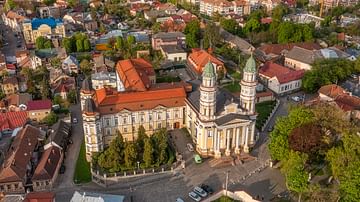
Holy Cross Cathedral, Uzhhorod
The Holy Cross Cathedral is the main Greek Catholic church of Uzhhorod, Ukraine and is the residence of the Mukachevo bishops. The cathedral was founded in 1640. The exterior of the cathedral is done in the neoclassical style.
Image
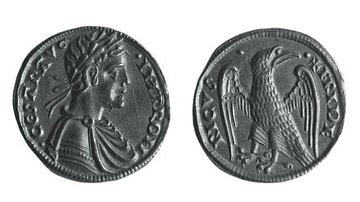
Coin of Holy Roman Emperor Frederick II
Gold coin of Holy Roman Emperor Frederick II, minted in Sicily between 1211-1250 CE. Weighs 5.2 grammes and measures 20 mm (British Museum, London)
Image
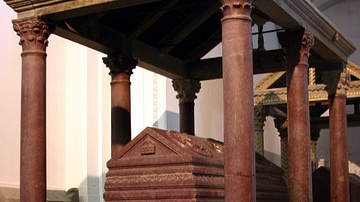
Tomb of Holy Roman Emperor Frederick II
Tomb of Holy Roman Emperor Frederick II (l. 1194-1250 CE) in Palermo, Sicily.
Image
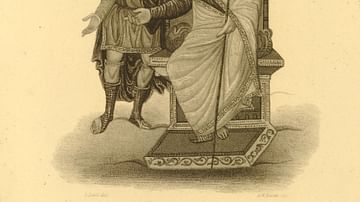
Illustration of Charles the Bald, Holy Roman Emperor
Illustration of an enthroned Charles the Bald, Holy Roman Emperor (r. 875-877 CE), King of West Francia (r. 843–877) and Italy (r. 875–877). Copied by G.W. Hutin, 1821, from a 9th-century manuscript of the Gospels. The British Museum, London...

Image
Holy Cross Episcopal Mission Used as Hospital at Wounded Knee
The Holy Cross Episcopal Mission, Wounded Knee, South Dakota, used as a hospital for the wounded Lakota Sioux following the Wounded Knee Massacre.
