
Search
Remove Ads
Advertisement
Search Results

Definition
Terracotta Army
The Terracotta Army refers to the thousands of life-size clay models of soldiers, horses, and chariots which were deposited around the grand mausoleum of Shi Huangdi, first emperor of China and founder of the Qin dynasty, located...

Definition
Lysander
Lysander (d. 395 BCE) was a Spartan statesman and general who famously defeated the Athenian navy at the Battle of Aigospotamoi in 405 BCE, which finally won the Peloponnesian War. Lysander gained a reputation for a fiery personality...

Definition
Pyrrhus - The King with Costly Victories
Pyrrhus (also Pyrrhos or Phyrrhus, c. 319 - 272 BCE ) was the king of Epirus in northern Greece between 306 and 302 BCE and again between 297 and 272 BCE. Winning great victories against the armies of Macedon...

Definition
Aztec Civilization - The Last Mesoamerican Empire
The Aztec Empire (c. 1345-1521) covered at its greatest extent most of northern Mesoamerica. Aztec warriors were able to dominate their neighbouring states and permit rulers such as Montezuma to impose...

Definition
Parthian Culture
Stretching between China and India in the east to the Mediterranean in the west, Parthia ruled over one of the widest expanses of empire in its time and Parthian culture flourished for 500 years (247 BCE to 224 CE). While known...

Definition
Peloponnesian League
The Peloponnesian League (c. 550 BCE - c. 366 BCE) was a loose confederation of Greek city-states led by Sparta. The League was the oldest and longest-lasting political association in the ancient Greek world. For Sparta, the...

Definition
Aethelred I of Wessex - The Forgotten Victor of the Battle of Ashdown
Aethelred I ruled the Kingdom of Wessex (southern England) from 865 to 871 and led the English resistance to the Viking invasions of Britain. He won the first English victory over the...

Definition
Shapur II
Shapur II (r. 309-379 CE, also Sapur II) was the tenth monarch of the Sassanian Empire (224-651 CE) and among the most successful. Under his reign – which lasted his entire life – the Avesta (Zoroastrian scripture) was committed to...
Definition
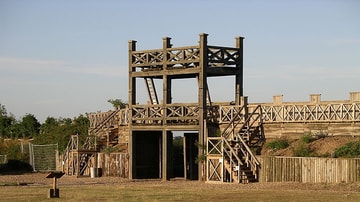
Roman Fort
The Roman army constructed both temporary and permanent forts and fortified military camps (castrum) across the frontiers of the empire's borders and within territories which required a permanent military presence to prevent indigenous...

Definition
Conquistador
The conquistadors, meaning "conquerors", were Iberian military adventurers who operated as the vanguard of empires in the 15th and 16th centuries by exploring areas of the world unknown to Europeans, defeating indigenous armies...
