
Search
Remove Ads
Advertisement
Search Results

Definition
Blitzkrieg - The Lightning War Tactic of Combined Arms
Blitzkrieg ('lightning war') is a military tactic combining air and land forces deployed at speed against the enemy's weaker points while the rear lines are simultaneously disrupted by acts of sabotage...
Definition
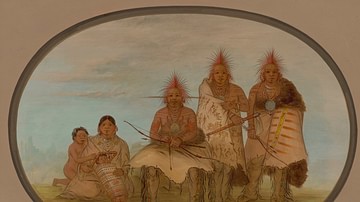
Pawnee
The Pawnee are a Native American nation of the Plains Indians culture originally from the region of modern Nebraska. Prior to the European colonization of the Americas, they were among the most powerful of the Plains Indian tribes numbering...

Definition
Roman Cavalry
Cavalry, although never replacing infantry as the mainstay of the Roman army, could provide useful cover on the flanks of armies, could be used as a shock tactic to cause disruption to enemy infantry formations, and could pursue...

Definition
Carthaginian Army
The armies of Carthage permitted the city to forge the most powerful empire in the western Mediterranean from the 6th to 3rd centuries BCE. Although by tradition a seafaring nation with a powerful navy, Carthage, by necessity...

Definition
Ashoka the Great
Ashoka the Great (r. 268-232 BCE) was the third king of the Mauryan Empire (322-185 BCE) best known for his renunciation of war, development of the concept of dhamma (pious social conduct), and promotion of Buddhism as well as...

Definition
Pushyabhuti Dynasty
The Pushyabhuti Dynasty (c. 500 CE - 647 CE) rose after the downfall of the Gupta Empire (3rd century CE - 6th century CE) in the 6th century CE in northern India. Also known as the Vardhana or Pushpabhuti Dynasty, the core...

Definition
Vercingetorix
Vercingetorix (82-46 BCE) was a Gallic chieftain who rallied the tribes of Gaul (modern-day France) to repel the Roman invasion of Julius Caesar in 52 BCE. His name means "Victor of a Hundred Battles" and was not his birth name...

Definition
Viking Ships
Viking ships were built by the Scandinavians during the Viking Age (c. 790 CE - c. 1100 CE) and were used both within Scandinavia and beyond for purposes ranging from being the most important means of transport to trade and warfare...

Definition
Peninsular War
The Peninsular War (1807-1814), also known as the War of Spanish Independence, was a major conflict of the Napoleonic Wars (1803-1815) that was waged in the Iberian Peninsula by Portugal, Spain, and the United Kingdom against the...

Definition
Neo-Assyrian Empire
The Neo-Assyrian Empire (912-612 BCE) was the final stage of the Assyrian Empire, stretching throughout Mesopotamia, the Levant, Egypt, Anatolia, and into parts of Persia and Arabia. Beginning with the reign of Adad Nirari...
