
Search
Remove Ads
Advertisement
Search Results

Definition
Ovid
Publius Ovidius Naso, more commonly known to history as Ovid (43 BCE - 17 CE), was one of the most prolific writers of the early Roman Empire. His works of poetry, mostly written in the form of elegiac couplets, influenced many of the...

Article
Alexander the Great & the Burning of Persepolis
In the year 330 BCE Alexander the Great (l. 356-323 BCE) conquered the Achaemenid Persian Empire following his victory over the Persian Emperor Darius III (r. 336-330 BCE) at the Battle of Gaugamela in...
Article
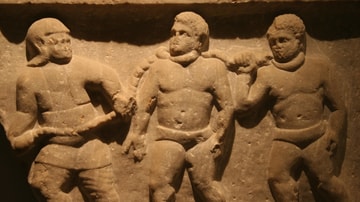
The Spartacus Revolt
The revolt of the gladiator Spartacus in 73-71 BCE remains the most successful slave revolt in the history of Rome. The rebellion is known as the Third Servile War and was the last of three major slave revolts which Rome suppressed...

Article
Women in the Byzantine Empire
Women in the Byzantine Empire (4th to 15th century CE) were, amongst the upper classes, largely expected to supervise the family home and raise children while those who had to work for a living did so in most of the...

Article
Gibbon's Decline & Fall of the Roman Empire
The English historian Edward Gibbon (1737-1794) wrote and published his seminal work History of the Decline and Fall of the Roman Empire between 1776 and 1788. The dominant theme of Gibbon's six-volume work...

Article
Parisian Salons & the Enlightenment
The salon was a notably French cultural event, a private social gathering where a mixture of guests openly discussed art, literature, philosophy, music, and politics. Salons were particularly but not exclusively...

Definition
Caesarion
Ptolemy XV Caesar “Theos Philopator Philometor” (“the Father-loving Mother-loving God”) (c. 47-30 BCE), better known by his unofficial nickname Caesarion or “Little Caesar” in Greek, was the oldest son of Cleopatra VII (69-30 BCE...

Definition
Bronze Age Collapse - The Decline and Fall of Mediterranean Civilization
The Bronze Age Collapse (also known as Late Bronze Age Collapse) is a modern-day term referring to the decline and fall of major Mediterranean civilizations during the 13th-12th centuries...

Definition
Roman Art
The Romans controlled such a vast empire for so long a period that a summary of the art produced in that time can only be a brief and selective one. Perhaps, though, the greatest points of distinction for Roman art are its very diversity...
Definition
Mo Ti
Mo Ti (l. 470-391 BCE, also known as Mot Tzu, Mozi, and Micius) was a Chinese philosopher of the Warring States Period (c. 481-221 BCE) associated with the Hundred Schools of Thought (different philosophical schools which established...
