
Search
Remove Ads
Advertisement
Search Results
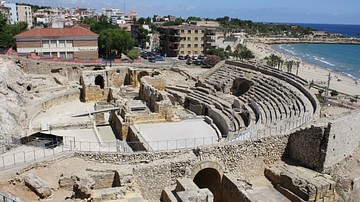
Image Gallery
A Gallery of 12 Roman Amphitheatres
In this gallery, we showcase 12 amphitheatres, a structure built throughout the Roman empire where ordinary people could watch such spectacles as gladiator games, mock naval battles, wild animal hunts, and public...

Image
Roman Street at Deultum
Roman Street at Deultum, photograph by Carole Raddato, Bulgaria, 16 August, 2024. A stone-paved Roman street beside the public baths of Deultum (modern Debelt), Bulgaria. The Roman colony was laid out on a regular street...

Image
Map of Roman North Africa - Provinces, Roads & Frontiers - Expansion, administration & economic foundations 146 BCE–395
Roman involvement in North Africa began with the destruction of Carthage in the Third Punic War (149-146 BCE), after which Rome established the...
Image
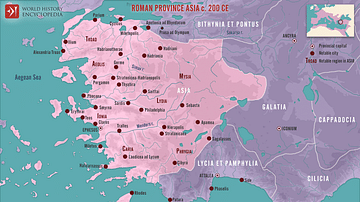
Roman Province Asia c. 200 CE
This map illustrates the Roman province of Asia around 200 CE. Established in 129 BCE following the bequest of the Attalid Kingdom of Pergamon to Rome, it encompassed western Anatolia (modern-day Turkey). It was a wealthy...
Image
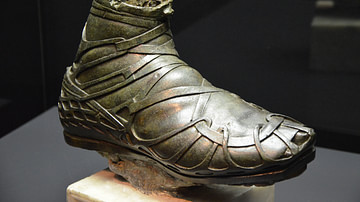
Bronze caliga from an over life-size statue of a Roman cavalryman
This bronze caliga was part of an over life-size statue of a Roman cavalryman from the 1st or the 2nd century CE. Caligae were heavy hob-nailed military boots worn by Roman legionary soldiers...

Image
Roman Province Bithynia et Pontus c. 200 CE
The Roman province of Bithynia et Pontus, established in 63 BCE after the defeat of Mithridates VI of Pontus, was a prosperous and strategically significant region by 200 CE. Located in northern Anatolia...

Image
Map of Roman & Parthian Trade Routes
This map shows the Roman-Parthian trade route system, circa between the 1st and the 3rd centuries CE. During this period, the Roman Empire and the Parthian Empire were the two superpowers of the region and the...

Video
Eros-Cupid and Psyche, the Greek and Roman Gods of Love and the Soul
Eros in Greek mythology, known as Cupid in Rome, is the god of love but more specifically, the god of physical and passionate desire. He is often referred to as a son and attendant of...
Image
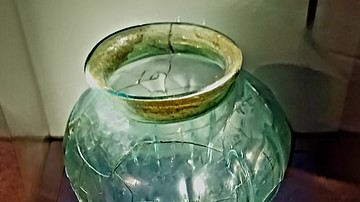
Roman Blue-Glass Cinerary Urn from Luguvalium
Roman blue-glass cinerary urn, from Luguvalium (Botchergate, Carlisle), 1st century CE. Carlisle Cathedral. Burning the body after death and keeping the bones and ashes in the cineraria (funerary urns...
Image
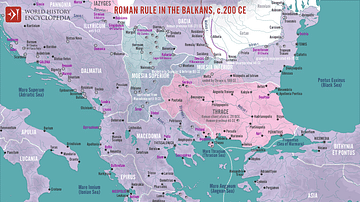
Roman Rule in the Balkans, c. 200 CE
A map illustrating Roman rule in the Balkans around 200 CE, characterized by significant administrative, military, and cultural integration into the Empire. The region was divided into several provinces (Moesia...
