
Search
Remove Ads
Advertisement
Search Results

Definition
Greek Archaic Period
The Greek Archaic Period (c. 800-479 BCE) started from what can only be termed uncertainty, and ended with the Persians being ejected from Greece for good after the battles of Plataea and Mykale in 479 BCE. The Archaic Period is preceded...
Definition
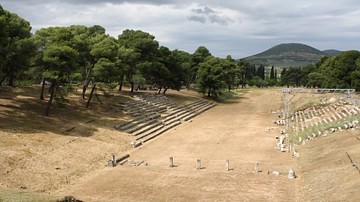
Stadium - The Sports Field of Ancient Greece
In the ancient Greek world, the word stadium or stadion referred to a measurement of distance, a foot-race, and the place where the race was held and observed by spectators. The Great Games Greek sporting events were closely connected...
Image
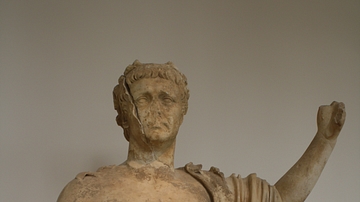
Claudius Statue, Olympia
A marble statue of the emperor Claudius as Jupiter (41-54 CE), provenance: Olympia. Olympia Archaeological Museum.

Article
Pherenike the Female Olympic Trainer
Pherenike (l. c. 388 BCE, also known as Kallipateira) was an athlete from Rhodes who, because she was a woman, could not compete in the Olympic Games and, as a married woman, was not allowed to even watch them. Defying these rules and risking...
Image
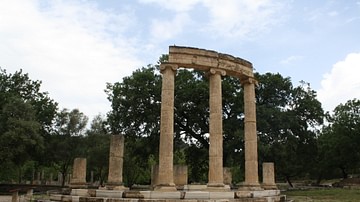
The Philippeion of Olympia
The Philippeion was erected by Philip II, King of Macedonia after the victory of Chaeroneia in 338 BCE. Originally there were 18 Ionic columns and inside were gold and ivory statues of Philip's family.
Image
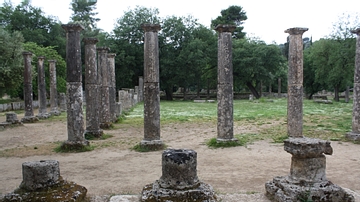
Palaestra, Olympia
The Palaestra where athletes trained and lived before events (3rd century BCE). Originally, there were 72 columns in the stoas.
Image
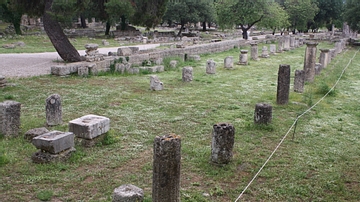
Gymnasion of Olympia
The Gymnasion was built in the second century BCE and was used as a training ground for the javelin, discus and running athletes.
Image
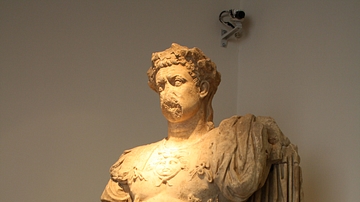
Titus Statue, Olympia
A marble statue of emperor titus (79-81 CE), Olympia Archaeological Museum. The corselet depicts two Nereids riding on sea monsters.

Image
Olympia by Manet
The 1863 oil on canvas painting, Olympia, by Edouard Manet (1832-83), the French modernist painter. The painting was exhibited in the 1865 Salon in Paris and shocked the art world for its presentation of a contemporary courtesan fully nude...
Image
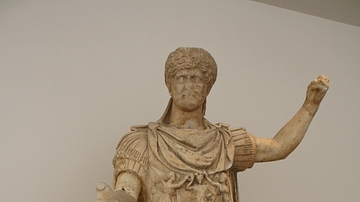
Hadrian Statue, Olympia
A marble statue of emperor Hadrian (117-138 CE), Olympia Archaeological Museum. The corselet depicts Athena standing on the wolf of Rome between two figures of Nike.
