
Search
Remove Ads
Advertisement
Search Results

Definition
Olympias
Olympias (c. 375-316 BCE) was the second wife of Philip II of Macedon (r. 359-336 BCE) and the mother of Alexander the Great (r. 336-323 BCE). Olympias was the driving force behind Alexander's rise to the throne and was accused of having...

Definition
Horae
The Horae (Horai, sing. Hora) were the personification and goddesses of the seasons and the hours and, later on, were regarded as goddesses of order and justice in Greek mythology. They were the daughters of Zeus and the Titaness Themis and...

Definition
Hesperides
The Hesperides are nymph-goddesses of the evening and the west in Greek mythology. They were the daughters of Atlas, the Titan who bore the heavens on his shoulders, and Hesperis, the personification of the west, or Nyx, the personification...

Definition
Tegea
Tegea was an ancient Greek city-state or polis in the southeast of Arcadia in the Peloponnese. The city participated in wider Greek affairs such as the Persian Wars of the early 5th century BCE and was a valuable ally of Sparta during the...

Article
Sicilian Temples (Greek Metrology)
Characteristics of Sicilian Archaic Temples The large dimensions of the components, the presence of a propteron, an adyton, and other specific elements of the plan and elevation speak for an originally very autonomous development of Sicilian...
Image
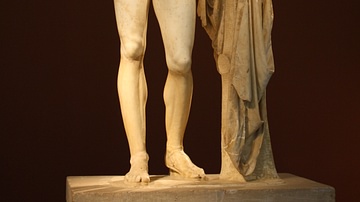
Hermes
The Hermes of Praxiteles, from the temple of Hera, Olympia (340-330 BCE). The infant is Dionysos. Olympia Archaeological Museum.

Image
Nike of Paionios
Marble statue of Nike, Olympia. Dedicated to Zeus by the Messenians and Naupaktians after their victory over Sparta in 424 BCE. Sculpted by Paionios of Mende. (Olympia Archeaological Museum, Greece).

Image
Greek Pankratiast
A bronze statue of a pankratiast (2nd century BCE). The leather thongs wrapped around the fist, worn by later exponents of this viiolent mix of wrestling and boixing, can be clearly seen. (Olympia Archaeological Museum, Olympia)
Image
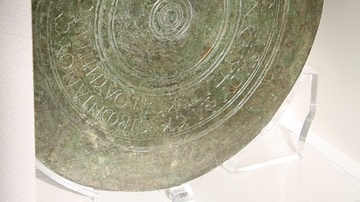
Bronze Discus
An inscribed bronze discus from Olympia dedicated by Publius Asklepiades (After 241 CE). Olympia Archaeological Museum.
Image
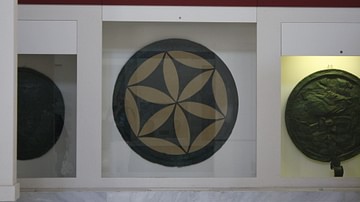
Greek Bronze Shield
Bronze shield from Olympia, 6th century BCE.
Olympia Archaeological Museum.
