
Search
Remove Ads
Advertisement
Search Results

Image
West Pediment, Temple of Zeus, Olympia
The west pediment of the temple of Zeus at Olympia representing the battle between the Lapiths and the Centaurs in Thessaly. Symbolic of the greek victory over barbarians or reason over savage nature. Severe style sculpture, c. 460 BCE. Olympia...

Image
Apollo, Olympia
Marble statue (severe style) of Apollo (c. 460 BCE) from the west pediment of the temple of Zeus, Olympia (Olympia Archaeological Museum).

Image
Pediment Detail, Temple of Zeus, Olympia
Lapith women from the west pediment of the temple of Zeus, Olympia in the severe style (c. 460 BCE). Olympia Archaeological Museum.

Image
Statue of Zeus, Olympia
An 19th century CE illustration of what the 5th century BCE statue of Zeus at Olympia, one of the Seven Wonders of the World, may have looked like.

Image
Statue of Zeus at Olympia, Reconstructed
A reconstruction of the Statue of Zeus at Olympia. The statue was built by Phidias in the 5th Century BCE and is one of the Seven Wonders of the Ancient World.

Image
Column Drums, Olympia
Column drums from the temple of Zeus at Olympia, 457 BCE. The central hole can be clearly seen which, with a wooden peg, helped hold the column drums in place.
Image
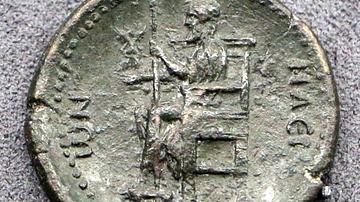
Statue of Zeus at Olympia on a Coin of Hadrian
A coin from the reign of Hadrian depicting the staute of Zeus at Olympia, on of the Seven Wonders of the World. 117-138 CE. (National Archaeological Museum, Florence)
Image
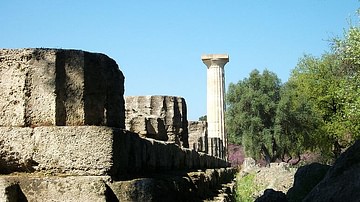
Crepidoma, Temple of Zeus, Olympia
The three steps of the crepidoma or crepis of the temple of Zeus at Olympia (457 BCE).
Image
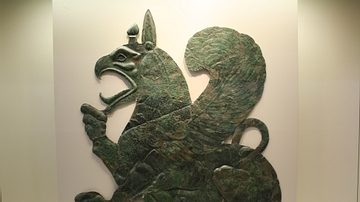
Griffin, Olympia
A bronze sheet griffin, perhaps once covering a wooden metope (630-620 BCE), Olympia, Olympia Archaeological Museum.

Definition
The Seven Wonders
The Seven Wonders of the Ancient World were seven impressive structures famously listed by ancient writers including Philo of Byzantium, Antipater of Sidon, Diodorus Siculus, Herodotus, Strabo, and Callimachus of Cyrene, among others. The...
