
Search
Remove Ads
Advertisement
Search Results

Definition
Phidias
Phidias (also Pheidias) was, according to his contemporaries, the most renowned of all Greek sculptors. His greatest masterpieces were completed between c. 465 and 425 BCE. Unfortunately, except through copies, no example of his work has...

Image
Hermitage Replica of the Statue of Zeus at Olympia
The statue in the Hermitage Museum St. Petersburg which imitates the now lost statue of Zeus at Olympia (dedicated c. 430 BCE), one of the Seven Wonders of the Ancient World.

Image
Stadium Entrance, Olympia
The Krypte, which was the official entrance to the stadium of Olympia (200 BCE).

Image
Starting Blocks, Olympia
The starting line of the stadium in Olympia (4th century BCE). Athletes had to place their toes in the front grooves on the block.

Image
The Zanes, Olympia
Stone bases of the Zanes of Olympia. These statues of Zeus were funded from fines from offending athletes in the Games. (4th century BCE).

Image
Statue of Zeus at Olympia
A silver tetradrachm from the reign of Alexander the Great (336-323 BCE) showing the statue of Zeus at Olympia (dedicated c. 430 BCE). (Corfu Bank Museum, Corfu)
Image
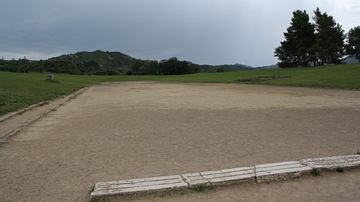
Stadium of Olympia
The stadium of Olympia (present form: 5th century BCE) with the starting line. The capacity at its maximum was 45,000.
Image
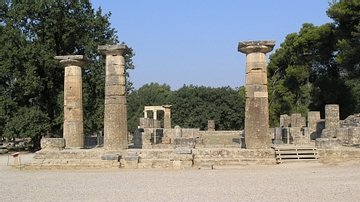
Temple of Hera, Olympia
Remains of the Temple of Hera in Olympia, Greece.

Image
Portrait of Olympia Fulvia Morata
A portrait of Olympia Fulvia Morata (l. 1526-1555, also given as Olimpia), the Italian scholar, poet, and writer who sought to advance the Protestant Reformation in Italy.
Image
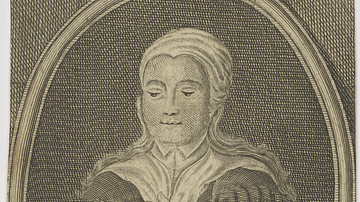
Olympia Fulvia Morata
Olympia Fulvia Morata, engraving from 1734.
Leipzig University Library.
