
Search
Did you mean: Hel?
Remove Ads
Advertisement
Search Results

Definition
Siddhartha Gautama
Siddhartha Gautama (better known as the Buddha, l. c. 563 - c. 483 BCE) was, according to legend, a Hindu prince who renounced his position and wealth to seek enlightenment as a spiritual ascetic, attained his goal and, in preaching...

Definition
Buddhism
Buddhism is a non-theistic religion (no belief in a creator god), also considered a philosophy and a moral discipline, originating in the region of modern-day India in the 6th and 5th centuries BCE. It was founded by the sage Siddhartha...

Definition
Gupta Empire
The Gupta Empire stretched across northern, central and parts of southern India between c. 320 and 550 CE. The period is noted for its achievements in the arts, architecture, sciences, religion, and philosophy. Chandragupta I (320...

Definition
Ancient Persian Culture
Ancient Persian culture flourished between the reign of Cyrus II (The Great, r. c. 550-530 BCE), founder of the Achaemenid Persian Empire, and the fall of the Sassanian Empire in 651 CE. Even so, the foundations of Persian...

Definition
Abbasid Dynasty
The Abbasids were an Arabic dynasty that initially ruled over most of the Islamic empire (save some western parts) after assuming the caliphate in 750 CE, later on, their empire fragmented, however, they retained spiritual supremacy...

Definition
Odyssey - Homer's Epic Poem of Redemption
Homer's Odyssey is an epic poem written in the 8th century BCE which describes the long voyage home of the Greek hero Odysseus. The mythical king sails back to Ithaca with his men after the Trojan War but is...
Definition
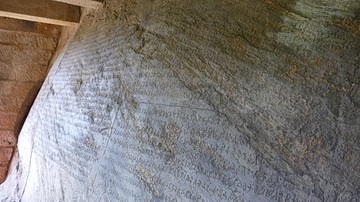
The Edicts of Ashoka the Great
The Edicts of Ashoka are 33 inscriptions engraved on pillars, large stones, and cave walls by Ashoka the Great (r. 268-232 BCE), the third king of the Mauryan Empire (322-185 BCE) of India. One set, the so-called Major...

Definition
Medieval Literature
Medieval literature is defined broadly as any work written in Latin or the vernacular between c. 476-1500, including philosophy, religious treatises, legal texts, as well as works of the imagination. More narrowly, however...

Definition
Hecate
Hecate (Hekate) is a goddess of Greek mythology capable of both good and evil. She was associated with witchcraft, magic, the Moon, doorways, and creatures of the night like hell-hounds and ghosts. Hecate often carries a torch in her...

Definition
Margery Kempe
Margery Kempe (l. c. 1373 - c. 1438 CE) was a medieval mystic and author of the first autobiography in English, The Book of Margery Kempe, which relates her spiritual journey from wife and mother in Bishop's Lynn, England to a chaste...
