
Search
Did you mean: Hatti?
Remove Ads
Advertisement
Search Results

Image
The Hittite Laws Tablet from Hattusa
This tablet's text is one of the latest versions of the Hittite laws text. In spite of some modifications (for example from the 16th century BCE versions), the articles of these two versions run parallel to each...

Image
Predictions Related to Lunar Eclipses Tablet from Hattusa
Lunar eclipses on different days throughout the year were interpreted and their meaning was given. For example: "...If there is a lunar eclipse on the day of the 6th month: A prince of the royal...
Image
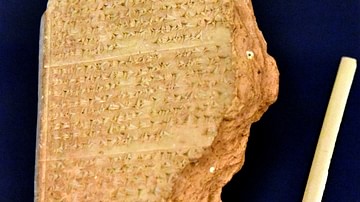
Epic of Gilgamesh Tablet from Hattusa
The cuneiform inscription on this clay tablet (VAT 12890) narrates part of the Epic of Gilgamesh (written c. 2150 - 1400 BCE). The obverse of this tablet relates the second dream of Gilgamesh on the journey to...

Image
The Soldiers' Oath Tablet from Hattusa
This clay tablet describes the ceremony of the oath taken by the Hittite soldiers and the cursing of those who fail to keep the oath. 13th century BCE, from Hattusa (Bogazkoy), in modern-day Turkey. (Museum of...

Image
The Song of Ullikummis Tablet from Hattusa
The most interesting Hittite legend embodying the characteristics of a Hurrian mythology is the one related to Kumarbiš, the father of the gods. Tešup has taken the palace of Kumarbiš at the head of the divine...

Image
Luwian Hieroglyphs in Hattusa
Luwian Hieroglyphs in Hattusa (the capital of the Hittite Empire) which adorned a chamber perhaps representing a symbolic entrance to the Underworld. The chamber was commissioned by Suppiluliuma II (1207–1178 BCE...

Image
Lion Gate of Hattusa
The Lion Gate at Hattusa, Turkey. This was one of the two city gates. The arc is typical for Hittite architecture.

Image
Lion Gate at Hattusa
The Lion Gate at Hattusa, the capital of the Hittite Empire. The gate, dated to the 13th century BCE, was flanked by two towers. The head of the lion on the left had already been broken away in antiquity. It has been reconstructed...

Definition
Hatti
The Hatti were an aboriginal people in central Anatolia (present-day Turkey) who first appeared in the area around the River Kizil Irmak. The prevailing understanding is that they were native to the land although it has been suggested...

Image
Recreation of Hattusa
A modern recreation of the Hittite city of Hattusa as it probably appeared in antiquity, by Rocío Espín.
Courtesy of Ancient Warfare Magazine / Karwansaray Publishers.
