
Search
Did you mean: Hatti?
Remove Ads
Advertisement
Search Results
Image
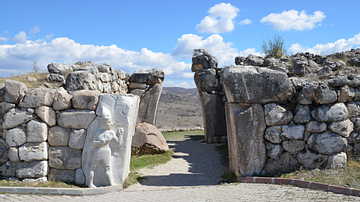
King’s Gate in Hattusa
The King’s Gate in Hattusa (the capital of the Hittite Empire in the Late Bronze Age) was part of the city's fortifications. The gate is decorated with a sculpture of the God of War in high relief and measuring 2.25m in height...

Image
Lion Gate of Hattusa
The Lion Gate at Hattusa, Turkey. This was one of the two city gates. The arc is typical for Hittite architecture.
Image
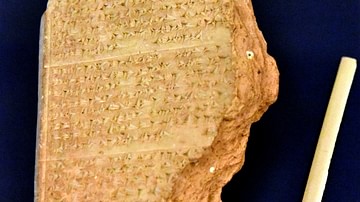
Epic of Gilgamesh Tablet from Hattusa
The cuneiform inscription on this clay tablet (VAT 12890) narrates part of the Epic of Gilgamesh (written c. 2150 - 1400 BCE). The obverse of this tablet relates the second dream of Gilgamesh on the journey to...
Image
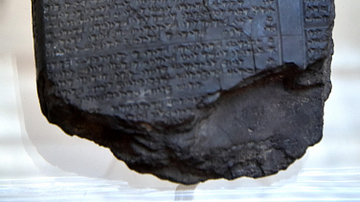
The Hittite Laws Tablet from Hattusa
This tablet's text is one of the latest versions of the Hittite laws text. In spite of some modifications (for example from the 16th century BCE versions), the articles of these two versions run parallel to each...

Image
Recreation of Hattusa
A modern recreation of the Hittite city of Hattusa as it probably appeared in antiquity, by Rocío Espín.
Courtesy of Ancient Warfare Magazine / Karwansaray Publishers.

Image
The Soldiers' Oath Tablet from Hattusa
This clay tablet describes the ceremony of the oath taken by the Hittite soldiers and the cursing of those who fail to keep the oath. 13th century BCE, from Hattusa (Bogazkoy), in modern-day Turkey. (Museum of...
Image
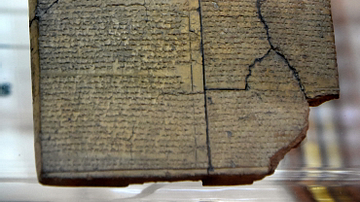
The Tablet of the Apology of Hattusilis III from Hattusa
This clay tablet starts with "...But when my father Mursilis (Muršiliš) became a god, and my brother Muwatallis (Mwuatalliš) sat upon the throne of his father, I became a general in the presence...

Image
The Song of Ullikummis Tablet from Hattusa
The most interesting Hittite legend embodying the characteristics of a Hurrian mythology is the one related to Kumarbiš, the father of the gods. Tešup has taken the palace of Kumarbiš at the head of the divine...

Image
The Deeds of Suppiluliuma I Tablet from Hattusa
In relating the wars waged by his father Suppiluliuma (Šuppiluliuma) I and the victories won, the Hittite king Mursili (Muršili) II mentions that after the death the Egyptian king Nibhururia (Tutankhamun...
Image
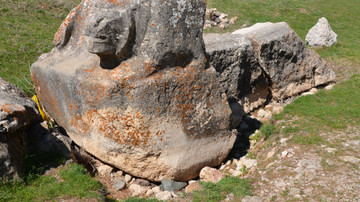
Hittite Lion Tub at Hattusa
A Hittite Lion Tub lying among the ruins of the Great Temple at Hattusa, the capital of the Hittite Empire. The basin was originally 5.5 metres long, and featured crouching lions at all four corners. It probably had a...
