
Search
Did you mean: Medea?
Remove Ads
Advertisement
Search Results

Definition
Mesopotamian Art and Architecture - The Birth of Art and Architecture in the Ancient World
Ancient Mesopotamian art and architectural works are among the oldest in the world, dating back over 7,000 years. The works first appear in northern Mesopotamia prior...

Definition
Nisaba - Sumerian Goddess of Writing and Scribe of the Gods
Nisaba (also Naga, Se-Naga, Nissaba, Nidaba, and associated with Nanibgal) is the Sumerian goddess of writing, accounts, and scribe of the gods. Although her name is commonly given as Nidaba...

Definition
Sumerian Language
The Sumerian language was spoken in southern Mesopotamia before the 2nd millennium BCE and was the first language to be written in the cuneiform script. It is an isolate language meaning we know of no other languages that relate...

Article
The Mesopotamian Pantheon - The Ancient Gods and Goddesses of the Near East
The gods of the Mesopotamian region were not uniform in name, power, provenance or status in the hierarchy. Mesopotamian culture varied from region to region and, because of this...

Article
A Brief History of Veterinary Medicine
The English word 'veterinarian' as defining one who provides medical care to animals, comes from the Latin verb veheri meaning “to draw” (as in "pull") and was first applied to those who cared for “any animal...
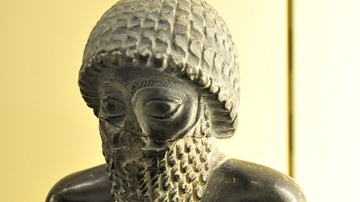
Image
Statue of Ur-ningirsu
The cuneiform inscriptions on the back of this small diorite statue (height 18 cm) read, "Dedicated to the god Ningizzida, his god, by Ur-ningirsu, priest-prince of Lagash, son of Gudea, priest-prince of Lagash." This...
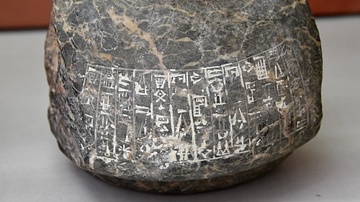
Image
Votive Mace Head of Ur-Ningirsu II from Girsu
This grey stone mace head was inscribed with a cuneiform text. The text says that this mace head was dedicated to the god Ningirsu by Ur-Ningirsu II (son of Gudea, ruler of Lagash). From Girsu, Sothern...
