
Search
Remove Ads
Advertisement
Search Results

Definition
Benjamin Hornigold
Captain Benjamin Hornigold was a British pirate active in the Caribbean and North Atlantic from 1716 to 1717. Hornigold’s greatest claim to fame (or infamy) is that he taught the pirating ropes to Edward Teach, aka Blackbeard...

Definition
William Dampier
William Dampier (1651-1715) was an English explorer, navigator, and naturalist, who was the first person to circumnavigate the world three times. He was also among the first Englishmen to step foot on Australian soil when he sailed...

Definition
Manila Galleon
The Manila galleons were Spanish treasure ships which transported precious goods like silk, spices, and porcelain from Manila in the Philippines to Acapulco, Mexico, between 1565 and 1815. The Atlantic treasure fleets then shipped...

Article
Seven Notorious Women Pirates
In this article, we look at the lives and deeds of seven notorious women pirates. There is Teuta, the Balkan enemy of ancient Rome; Alwilda, the Scandinavian princess who chose a life of crime on the High Seas; Maria...
Image
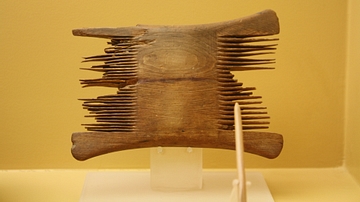
Greek Wooden Comb
A wooden comb from the Agora of Athens. (Agora Museum, Athens).

Image
Greek Glass Amphoriskos from Amman
An amphoriskos is a small amphora, typically less than 4 inches in height. Polychrome and sand-core formed. The decoration and the technique used are very similar to Phoenician glass, reflecting the trade and cultural...

Image
Greek Lead Weights
Standard lead weights from the agora of Athens. 5th-2nd century BCE. (Agora Museum, Athens)

Image
Greek Ceramic Toys
Artefacts of the ancient city of Amphipolis displayed in the Museum. Children's toys.
Location: Amphipolis, Macedonia, Greece. 1st Century BCE - 1 Century CE

Image
Greek Symposium Scene
A scene from an Attic red-figure drinking cup showing two males at a symposium. First half of the 5th century BCE. (Mykonos Archaeological Museum)
Image
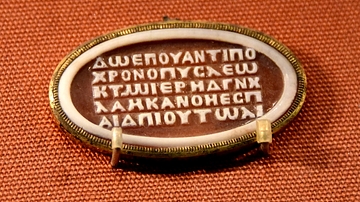
Sardonyx Cameo Showing Nonsense Greek Inscription
Skillful Roman cameo-carvers exploited the tonal contrast of some stones. This could be a simple two-tone contrast or a more subtle variation using all available gradations of shade. Sardonyx was particularly...
